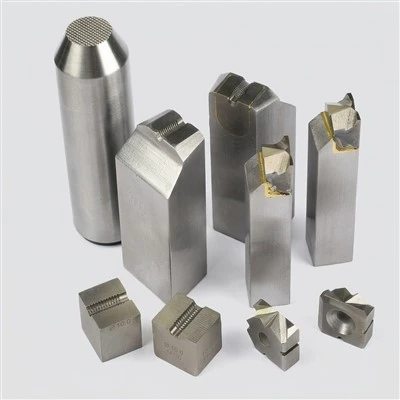
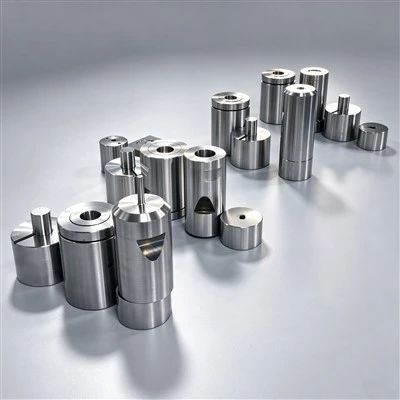
Key Structural & Metallurgical Advantages
High-Impact Carbide Matrix
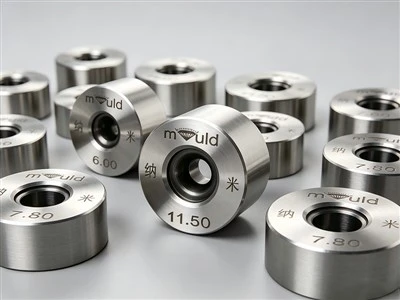
Coarse-to-medium grain tungsten carbide bound with 15–25% cobalt absorbs cyclic shock loads up to 4,800 MPa without catastrophic brittle fracture during heavy wire upsetting.
Pre-Stressed Steel Casing Protection
H13/Cr12MoV outer casings applied via precision thermal interference shrink-fitting exert continuous radial compressive stress on the carbide nib, preventing hoop-stress cracking under extreme cold forging pressure.
Low-Friction Internal Cavity
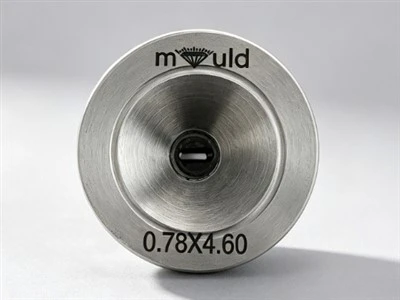
Diamond-polished working zones (Ra ≤ 0.05 µm) minimize frictional heating, eliminate wire metal pickup/galling, and prevent premature die wall scoring.
Tight Axial Alignment
Concentricity within 0.003 mm ensures symmetric material deformation, precise head geometry, zero shank offset, and minimal flash formation in high-speed cold headers.
|
Parameter |
Specification |
Manufacturing Standard |
|
Carbide Insert Grade |
YG15 / YG20 / YG20C / YG25 |
ISO K30–K40 / GB/T 18376.1 |
|
Cobalt Binder Content |
15% – 25% wt% |
Controlled phase magnetic saturation |
|
Hardness (HRA) |
82.0 – 87.5 HRA |
ASTM B294 |
|
Transverse Rupture Strength (TRS) |
2,800 – 3,800 N/mm² |
ISO 3327 / ASTM B406 |
|
Compressive Strength |
4,000 – 4,800 MPa |
ASTM E9 |
|
Grain Size Distribution |
1.2 – 3.5 µm (Medium-Coarse) |
Metallographic etched grain analysis |
|
Concentricity & Runout |
≤ 0.003 mm |
ISO 230-1 / Laser interferometry |
|
Outer Steel Casing |
Cr12MoV / H13 (1.2344) / 40Cr |
Quenched & Tempered (58–62 HRC) |
|
Assembly Pre-Stress Mode |
Thermal Shrink-Fitting (1.8–2.5‰ interference) |
Controlled stress interference calculation |
|
Internal Cavity Roughness |
Ra 0.05 – Ra 0.1 µm |
Mirror polishing via diamond paste |
Core Application Scenarios
High-Strength Fastener Forging
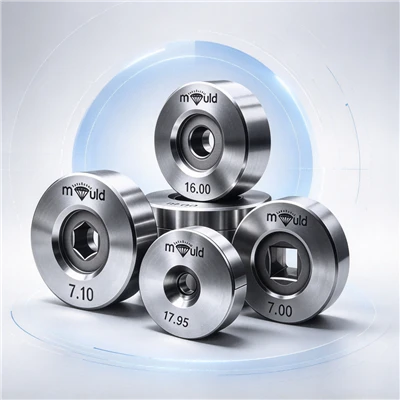
Cold heading 8.8, 10.9, and 12.9 grade hex bolts, socket cap screws, carriage bolts, and self-tapping screws.
Automotive & Aerospace Hardware
Mass production of critical engine studs, wheel lug bolts, ball joint pins, and structural solid rivets.
Specialty Component Upsetting
Multi-station cold shaping of electrical contact rivets, stepped pins, tubular rivets, and custom asymmetric metal hardware.
Quality Control & Testing Protocol
Ultrasonic Flaw Detection (UT): 100% volumetric scanning of raw carbide blanks to detect internal micro-voids, porosity, and cobalt pooling.
Coercivity & Magnetic Saturation Testing: Non-destructive verification of carbide grain size and binder phase distribution to prevent premature wear or brittleness.
CMM & Laser Bore Profiling: 3D coordinate and laser scanning of internal taper angles, fillet radii, land lengths, and concentricity.
ISO 9001:2015 Traceability: Batch-level material certification linking raw powder heat numbers to finished die serial numbers.

FAQ
Q: How do cobalt content and carbide grain size affect the performance of heading dies?
A: Cobalt content determines the toughness-to-hardness ratio. Higher cobalt levels (15%–25%) increase impact toughness and flexural strength (TRS up to 3,800 N/mm²), preventing die shattering under heavy shock loads. Medium-to-coarse grain sizes (1.2–3.5 µm) further enhance resistance to micro-cracking during cold Upsetting, whereas fine grains suit lighter, high-wear applications.
Q: Why is thermal shrink-fitting mandatory for carbide heading die assembly?
A: Tungsten carbide exhibits extremely high compressive strength but relatively low tensile strength. During cold forging, internal pressures create severe outward hoop stresses. Pressing or thermal shrink-fitting the carbide insert into a hardened steel casing (H13/Cr12MoV) with a 1.8‰–2.5‰ interference fit applies continuous external radial compression, counteracting internal tensile forces and preventing longitudinal splitting.
Q: How does inner cavity polishing (Ra ≤ 0.05 µm) improve fastener production quality?
A: High forging pressure forces wire material into direct contact with the die wall. A diamond-polished mirror finish drastically lowers the friction coefficient, preventing galling (material transfer) and surface scoring. This reduces the force required for part ejection, eliminates head/shank defects on fasteners, and extends overall die operational lifespan.
Hot Tags: carbide heading dies, China carbide heading dies manufacturers, suppliers, factory