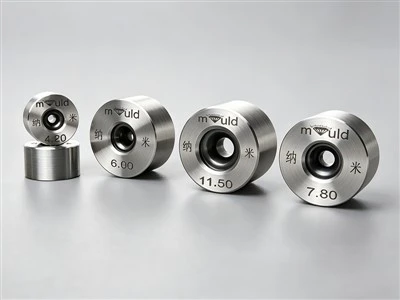
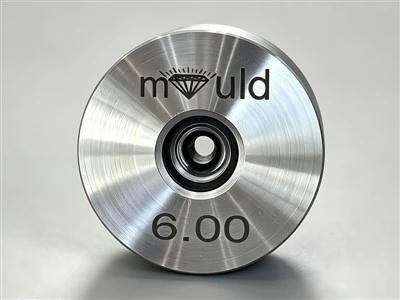
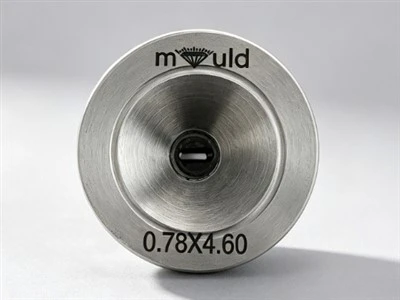
NDCD dies are designed for wire-drawing applications where large bore dimensions, controlled wire diameter, and resistance to bearing wear are required. They can be considered when a large PCD die is difficult to manufacture or when an uncoated carbide die experiences excessive bore wear under continuous drawing.
The die is integrated into the drawing machine between the wire guide and drawing block/capstan. As the wire passes through the coated bore, the reduction zone decreases its cross-sectional area and the bearing controls the finished diameter.
Structure and Manufacturing
A typical NDCD die consists of:
- Cemented carbide substrate
- CVD nano-diamond coating
- Entry and reduction zone
- Bearing/sizing section
- Exit zone
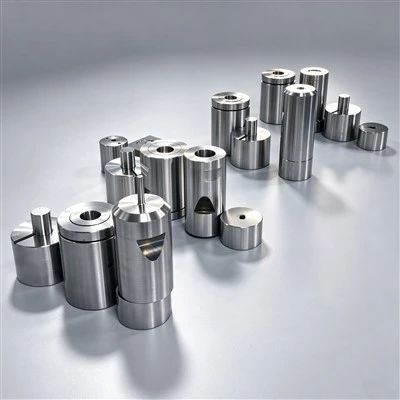
- Die holder, where required
The diamond layer is deposited onto the prepared carbide surface using a Chemical Vapor Deposition (CVD) process. Coating adhesion, surface preparation, coating thickness, and bore geometry are important manufacturing parameters because the coating is exposed directly to continuous wire contact.

Operating Conditions
During drawing, the die is subjected to radial contact pressure, drawing tension, sliding friction, and friction-generated heat. Actual drawing force and temperature depend on wire material, reduction per pass, drawing speed, die geometry, and lubrication.
Production should therefore monitor drawing speed, lubricant temperature and flow, drawing tension, finished-wire diameter, and bore wear. There is no universal pressure or temperature rating for all NDCD dies; operating limits must be established according to the specific die and drawing process.
Failure Modes
Common failure modes include bore wear, coating cracking, coating delamination, localized wear, and wire scratching. A gradual increase in finished-wire diameter can indicate bearing wear, while longitudinal scratches may indicate coating damage or contaminated lubricant.
Incorrect die alignment can also produce uneven wear on one side of the bore. For this reason, die centering, wire-guide alignment, lubricant cleanliness, and incoming wire condition should be checked when abnormal wear occurs.
Procurement Parameters
For B2B purchasing, provide the manufacturer with:
Wire material + incoming diameter + finished diameter + reduction per pass + drawing speed + lubrication method + required bore + die-holder dimensions + machine type.
For large-bore applications, these parameters determine the carbide substrate, CVD diamond coating configuration, bore geometry, and bearing dimensions.
FAQ
Q: What information is required to order NDCD Wire Drawing Dies?
A: The manufacturer normally needs the wire material, incoming diameter, finished diameter, die bore, reduction per pass, drawing speed, lubrication method, and die-holder dimensions. For replacement dies, previous die dimensions and actual production results can also help determine whether the bore or coating specification needs adjustment.
Q: When should I choose an NDCD Die instead of a PCD Die?
A: NDCD Dies can be considered when the application requires a relatively large bore combined with a wear-resistant diamond working surface. PCD may become more difficult to manufacture as bore size and geometry increase, while NDCD uses a cemented carbide substrate with a CVD diamond coating.
Q: What wire materials can be drawn with NDCD Dies?
A: NDCD Dies can be designed for selected copper, aluminum, brass, and other non-ferrous wire or rod drawing applications. Selection should be based on the material hardness, incoming diameter, reduction ratio, drawing speed, lubrication, and required finished-wire tolerance.
Q: How does die wear affect the finished wire?
A: As the coated bearing wears, the effective bore can gradually increase, causing the finished wire diameter to move above the target value. Diameter drift, increasing ovality, or new surface scratches are practical indicators that the die should be inspected.
Q: What causes premature failure of an NDCD Die?
A: Common causes include poor lubrication, contaminated drawing fluid, excessive reduction per pass, high drawing speed, die misalignment, abnormal incoming wire surfaces, and mechanical impact during installation. Coating cracking or delamination should also be checked when the failure is concentrated in the diamond layer.
Q: How should NDCD Dies be installed in a drawing machine?
A: The die is normally mounted in the machine's die box or die holder and aligned with the wire centerline. Before production, the operator should check die seating, concentricity, wire-guide alignment, lubricant supply, and the condition of the coated bore to prevent uneven loading.
Hot Tags: ndcd wire drawing dies, China ndcd wire drawing dies manufacturers, suppliers, factory