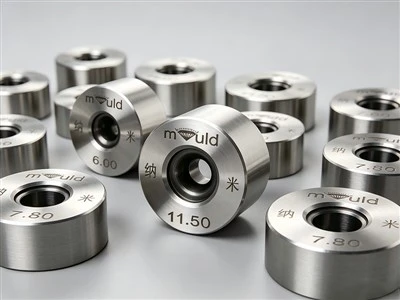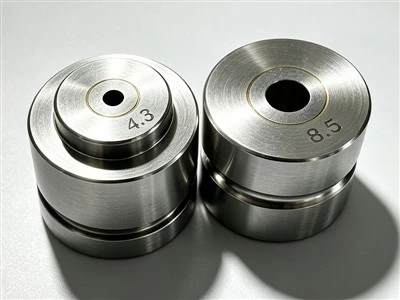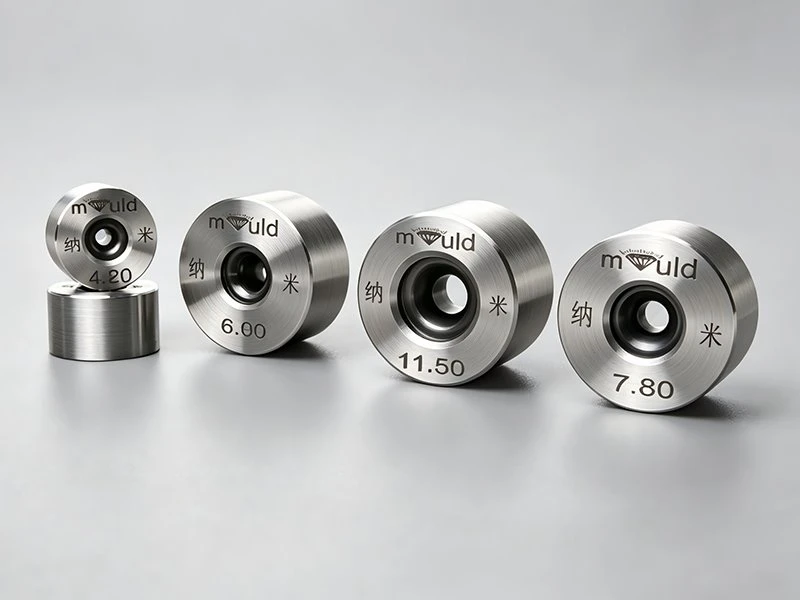
Nano Diamond Coated Die vs. PCD Die
The key difference is the structure of the working material.
|
Item |
Nano Diamond Coated Die |
PCD Die |
|
Main structure |
Cemented carbide + diamond coating |
Polycrystalline diamond |
|
Diamond form |
CVD diamond coating |
Consolidated diamond grains |
|
Large bore fabrication |
Suitable for selected large-bore designs |
More difficult as bore size increases |
|
Substrate |
Cemented carbide |
PCD working element with support structure |
|
Working surface |
Diamond coating |
PCD material |
|
Main engineering consideration |
Coating adhesion and wear |
PCD geometry and manufacturing limitations |
|
Typical selection factor |
Bore size + wear requirement |
Wear resistance + bore/application range |
Large-bore wire drawing dies create a material and manufacturing challenge. PCD dies become more difficult to manufacture as the required bore size and geometry increase, while conventional cemented carbide can be machined into larger holes but may experience significant bore wear during continuous drawing.
Nano Diamond Coated Dies address this combination by using cemented carbide as the structural substrate and a CVD diamond coating as the working surface. The carbide provides the required mechanical support and large-bore geometry, while the diamond coating protects the working area against abrasive and sliding wear.
Die Structure
A typical Nano Diamond Coated Die consists of:
Cemented carbide substrate
CVD diamond coating
Entry cone
Reduction zone
Bearing / sizing section
Exit zone
Metal die holder, depending on the machine configuration
The cemented carbide provides the bulk mechanical structure, while the CVD diamond layer is deposited onto the selected working surface. The final die geometry is determined by the required incoming wire diameter, finished diameter, reduction per pass, and drawing conditions.

CVD Diamond Coating Process
The working surface is produced using Chemical Vapor Deposition (CVD). During deposition, carbon-containing gases are introduced into a controlled process environment, where carbon atoms form a diamond structure on the prepared cemented carbide substrate.
The coating process must control parameters such as substrate preparation, deposition temperature, gas composition, pressure, coating thickness, adhesion, and surface morphology. These factors influence whether the diamond layer remains firmly bonded to the carbide during repeated mechanical and thermal loading.
The exact CVD process parameters depend on the coating equipment and coating formulation and should be specified by the coating manufacturer rather than treated as one universal value.
Why Use Cemented Carbide as the Substrate?
Cemented carbide provides the mechanical body required for a relatively large die bore and can be manufactured into different external dimensions and internal geometries.
However, an uncoated carbide bore is exposed directly to continuous wire contact. Depending on wire material, drawing speed, reduction ratio, and lubrication, the bearing area can gradually wear and cause the finished wire diameter to increase.
The Nano Diamond Coated Die therefore separates the two functions: cemented carbide provides structural support, while the CVD diamond layer provides the wear-resistant working surface.
Large-Bore Wire Drawing Applications
The main application area is wire drawing where the die requires a relatively large aperture that is difficult or uneconomical to produce using conventional PCD construction.
Typical applications can include large-diameter non-ferrous wire and rod drawing, depending on the die design and coating specification. The actual suitability should be determined from the incoming diameter, finished diameter, wire material, reduction per pass, drawing speed, lubrication, and required die life.
A typical process is:
Wire Rod → Pre-Forming / Rough Drawing → Large-Bore Drawing Die → Intermediate Drawing → Final Sizing → Diameter Inspection → Take-Up
The Nano Diamond Coated Die is normally integrated into the appropriate upstream or intermediate drawing stage according to the required reduction schedule.
Installation and System Integration
Nano Diamond Coated Dies are installed into the die box or die holder of a wire drawing machine. The die must be aligned with the wire centerline to distribute contact pressure evenly around the coated bore.
A typical installation sequence is:
Wire Guide → Lubrication → Nano Diamond Coated Die → Drawing Block / Capstan → Diameter Inspection → Take-Up
Before production, the operator should check die seating, concentricity, wire-guide alignment, lubricant supply, and the condition of the coated bore. During operation, changes in wire diameter or surface condition should be recorded to determine coating wear or process-related problems.
Hot Tags: nano diamond coated dies, China nano diamond coated dies manufacturers, suppliers, factory