Key Parameters
|
Parameter |
Why It Matters |
|
Wire material |
Influences forming load and carbide selection |
|
Incoming size |
Determines the starting cross-section |
|
Finished profile |
Defines groove geometry |
|
Width and thickness |
Controls final dimensions |
|
Corner radius |
Defines profile edges |
|
Reduction per pass |
Determines deformation level |
|
Roll diameter |
Must match the rolling equipment |
|
Groove dimensions |
Directly affect finished-wire geometry |
|
Rolling speed |
Influences operating conditions |
|
Dimensional tolerance |
Determines required machining accuracy |
For shaped wire, a cross-sectional drawing is strongly recommended because width and thickness alone may not define the complete profile.
Forming Rolls vs. Wire Drawing Dies
|
Feature |
Forming Rolls |
Wire Drawing Dies |
|
Forming method |
Rolling |
Drawing |
|
Main force |
Compression |
Tensile force |
|
Tool |
Rotating roll |
Fixed die |
|
Working geometry |
Groove/profile |
Die opening |
|
Main purpose |
Profile forming |
Wire reduction and sizing |
|
Contact |
Rolling contact |
Sliding contact |
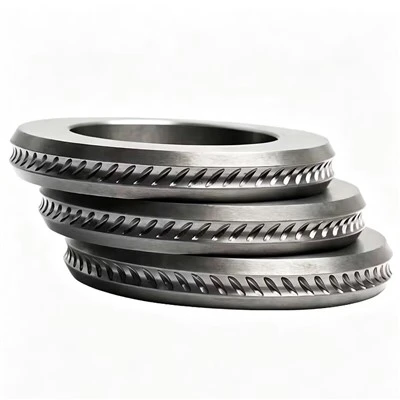
A tungsten carbide forming roll consists of a wear-resistant carbide working surface with a precision-machined groove or profile.
Unlike a simple sizing roll, a forming roll is designed primarily around the desired cross-sectional geometry of the finished wire.
Typical profiles include:
- Round to flat
- Round to rectangular
- Round to square
- Flat to rectangular
- Oval wire
- Special-shaped wire
- Custom asymmetric profiles
The roll profile can be manufactured according to a technical drawing or finished-wire specification.
How Wire Forming Rolls Work
The forming process can be simplified as:
Incoming Wire → Roll Groove → Compression → Profile Deformation → Finished Wire
The wire is progressively formed as it passes through the roll groove.
For larger dimensional changes, multiple forming passes may be used. Each pass provides a controlled amount of deformation rather than requiring the complete profile to be formed in one operation.
The final result depends on:
- Wire material
- Initial cross-section
- Roll groove geometry
- Reduction per pass
- Roll diameter
- Rolling speed
- Number of forming passes

FAQ
Q: What are Tungsten Carbide Forming Rolls for Wire?
A: They are carbide rolling tools used to change the cross-sectional shape and dimensions of metal wire through controlled compression.
Q: What wire materials can be formed?
A: Depending on the roll design and carbide grade, forming rolls can be used for copper, aluminum, steel and other metal wires.
Q: Can forming rolls produce rectangular wire?
A: Yes. The groove can be designed for rectangular, flat, square and other custom profiles.
Q: Can the groove profile be customized?
A: Yes. Groove geometry can be manufactured according to a technical drawing, finished-wire sample or specified dimensions.
Q: What information is needed for a quotation?
A: Provide the wire material, incoming size, finished profile, corner radius, dimensional tolerance, roll dimensions, machine information and forming conditions.
Hot Tags: tungsten carbide forming rolls for wire, China tungsten carbide forming rolls for wire manufacturers, suppliers, factory