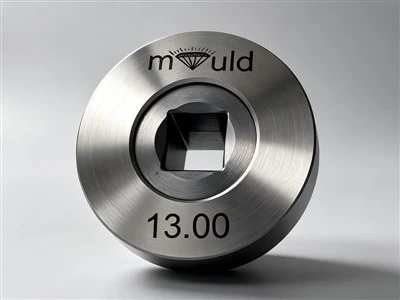
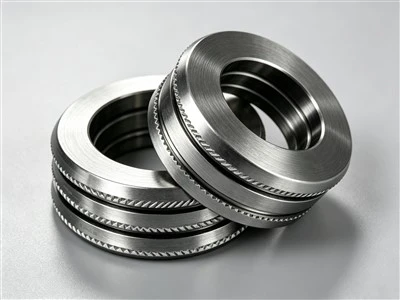
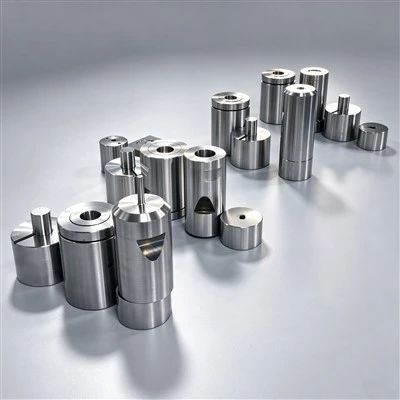
A mono diamond wire drawing die is a drawing die whose core is a single, continuous diamond crystal. Also called a single crystal diamond die, monocrystalline diamond die, MCD die or SSCD die, it is produced from synthetic diamond grown under high-pressure / high-temperature (HPHT) conditions, then laser-drilled and ultrasonically polished to a mirror finish.
Because the core has no grain boundaries, no metallic binder and no natural-stone flaws, the bore holds its diameter for millions of metres and delivers the lowest drawing friction of any die material. Mono diamond dies are the industry standard for drawing fine and ultra-fine wire below approximately 1.5 mm - copper and tinned copper, gold and silver bonding wire, tungsten, molybdenum, stainless steel and plated wire.
Key takeaways for procurement teams
Material: mono diamond = monocrystalline (single crystal) diamond. One continuous crystal lattice, zero binder phase, zero grain pull-out.
Sweet spot: fine and ultra-fine wire from 0.015 mm to 1.5 mm (0.0006" to 0.059"). Most die shops standardise on mono diamond below 0.5 mm.
Cost logic: the lowest friction and the best bore finish of any die material; the higher unit price is offset by dramatically longer life, fewer wire breaks and lower scrap on precious metals.
Lifecycle: mono diamond dies can be re-drilled and re-polished to the next size up - a usable die is rarely scrapped before 3–6 recuts.
Watch-out: single crystal diamond is brittle. Correct alignment, filtered lubricant and clean incoming rod matter more here than with PCD or carbide.
Five technical reasons mono diamond outperforms other die materials
1Continuous lattice
One crystal means uniform wear around the full circumference. No grain pull-out, no binder leaching, no out-of-roundness drifting over the life of the die.
2Highest thermal conductivity
Diamond conducts heat at roughly 2,000 W/(m·K). Drawing heat leaves through the core instead of into the wire, protecting temper, coating and surface metallurgy.
3Mirror bore finish
Bores polished to Ra ≤ 0.02 µm cut friction and drawing force, eliminating the micro-scoring that shows up later as plating defects or bonding failures.
4Dimensional stability
Bore diameter barely moves across millions of metres, so the wire diameter you qualify on day one is the diameter you get on day 300.
5Extreme hardness
HV 9,000–10,000 makes monosuitable for abrasive and hard-drawn materials such as tungsten, molybdenum and high-carbon alloys.
6Recut economics
When a pass wears out, the core is re-drilled to the next size up and returned to service - a second and third life from one purchase order.
Mono diamond die specifications
The table below covers our standard synthetic single crystal diamond range. Custom bores, casings and profiles are produced to drawing for OEM and single-wire machines.
| Parameter | Specification |
|---|---|
| Core material | Synthetic monocrystalline diamond (HPHT, (111) orientation); natural diamond available on request |
| Aperture (hole) range | 0.015 mm – 1.50 mm (0.0006" – 0.059") |
| Bore tolerance | ±0.0005 mm in the ultra-fine range; ±0.001 – ±0.002 mm for larger apertures |
| Roundness (out-of-round) | ≤ 0.5 µm |
| Bore surface roughness | Ra ≤ 0.02 µm (mirror polish) |
| Core hardness | HV 9,000 – 10,000 |
| Thermal conductivity | ≈ 2,000 W/(m·K) |
| Reduction angle tolerance | ±2° |
| Standard casing (outer shell) | Ø25 × 8 mm / Ø25 × 10 mm / Ø28 × 12 mm / Ø28 × 16 mm - stainless steel or brass |
| Casing concentricity | Within 0.01 mm between bore axis and casing OD |
| Recommended area reduction | 5 – 33 % depending on wire material (see selection table below) |
| Temperature behaviour | High thermal stability - suitable for hot drawing of tungsten |
| Recut / re-polish service | Supported - core re-drilled to next size up |
| Minimum order quantity | 1 piece - standard sizes (0.20 / 0.25 / 0.30 / 0.35 / 0.40 mm) held in stock |
Bore geometry: the five zones that decide wire quality
A mono diamond die is not simply a hole. Its performance comes from the five-zone profile machined into the crystal. Get the reduction angle or the bearing length wrong and even a flawless diamond will produce chatter marks, ovality or wire breaks.

Reduction angle and bearing length by wire material
Use this table as a starting point when specifying a mono diamond die. Values are typical industry practice and will be fine-tuned to your drawing machine, speed and elongation schedule on request.
| Wire material | Blending | ReductionRecommended die geometry by wire materia angle | Bearing length |
|---|---|---|---|
| Bare copper wire | Well blended | 18° ± 2° | 40 % ± 10 % |
| Aluminium wire | Well blended | 20° ± 2° | 25 % ± 10 % |
| Tin- or silver-plated copper | Very well blended | 20° ± 2° | 20 % ± 10 % |
| Stainless steel wire | Lightly blended | 14° ± 2° | 50 % ± 10 % |
| Tungsten / molybdenum wire | Lightly blended | 14° ± 2° | 50 % ± 10 % |
| Brass / copper-clad steel | Lightly blended | 12° ± 2° | 35 % ± 10 % |
Mono diamond vs PCD vs nano-coated vs tungsten carbide
Choosing a die material is a lifecycle-cost decision, not a price-per-piece decision. The matrix below compares the four materials we manufacture across the criteria that actually drive cost per drawn tonne.
| Criteria | Mono / single crystal diamond | PCD (polycrystalline) | Nano-coated carbide | Tungsten carbide |
|---|---|---|---|---|
| Structure | One continuous crystal, no binder | Sintered micro-crystals + Co binder | CVD nano-diamond layer on WC substrate | WC grains + Co binder |
| Hardness | HV 9,000–10,000 | HV 6,000–8,000 | HV 4,000–6,000 | HV 1,300–1,800 |
| Bore finish | Ra ≤ 0.02 µm (mirror) | Very good | Very good | Good |
| Dimensional stability | Excellent - sub-micron drift over millions of m | Excellent | Good | Moderate - drifts with wear |
| Thermal conductivity | Highest (≈2,000 W/m·K) | High | Good | Moderate |
| Fracture toughness | Low - brittle, alignment-critical | Very good | High | Outstanding |
| Best wire size | 0.015 – 1.5 mm | 0.10 – 2.5 mm | 0.05 – 2.5 mm | 0.10 – 6.0 mm+ |
| Typical wires | Bonding wire, fine Cu, tungsten, stainless, precious metals | Cu, Al, brass, stainless, high-speed runs | Welding wire, tire cord, stranding | Steel, welding wire, large-gauge roughing |
| Can be recut / re-polished | Yes - multiple recuts | Yes, limited | No - coated layer is consumed | Yes - easy and repeated |
| Relative unit cost | High | Medium–high | Medium–high | Low |
| Best used for | Ultra-fine and fine wire where finish and diameter consistency are non-negotiable | High-volume non-ferrous and stainless drawing | Abrasive wire where carbide wears too fast | Roughing passes, large diameters, impact resistance |
Selection rule of thumb
Roughing / large gauge (>1.5 mm): tungsten carbide for toughness and cost.
Intermediate and high-volume non-ferrous: PCD for wear life and productivity.
Finishing and ultra-fine (<1.5 mm, often <0.5 mm): mono diamond for finish, precision and stability.
Best practice: most efficient lines mix materials down the same block - carbide first, PCD in the middle, mono diamond on the final passes.
Where mono diamond dies are used
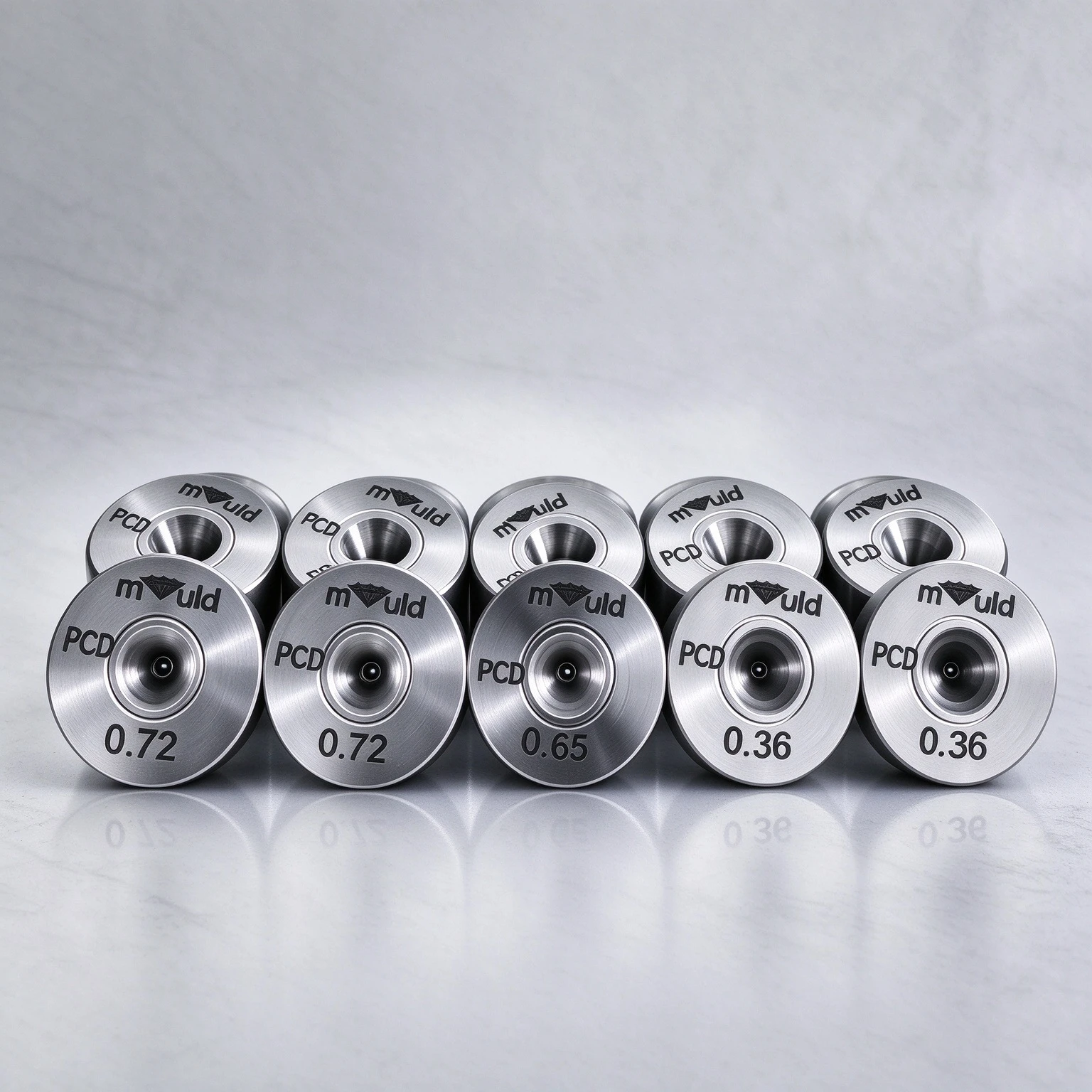
Mono diamond dies are specified wherever the wire surface, the wire diameter or the value of the raw material makes scrap unacceptable.
Application Sectors
Electronics and bonding
Gold and copper bonding wire, semiconductor lead wire, high-purity conductor for connectors and sensors.
Magnet and enamel wire
Fine and ultra-fine bare and tinned copper for motors, transformers, inductors and EV traction windings.
Lighting and heating
Tungsten and molybdenum filament wire, resistance wire, thermocouple wire, halogen and LED lead wire.
Medical devices
Guidewire, catheter braid wire, implant and orthodontic wire where surface integrity is a regulatory requirement.
Precious metals
Gold, silver, platinum and rhodium wire for jewellery, plating anodes and precision instruments - where every gram of scrap counts.
Specialty alloys
Stainless steel, plated and clad wire, nickel alloys, thermostatic bimetal and shape-memory wire.
How we make and verify every mono diamond die
Our Hejian plant has produced diamond and carbide tooling since 1962. Every mono diamond die passes through the same controlled sequence:
Crystal selection and orientation
The HPHT mono crystal is inspected and aligned so the drilled bore runs along the optimal crystallographic direction.
Laser drilling
The bore is drilled slightly undersize, leaving allowance for the recut service that extends die life.
Ultrasonic shaping
Diamond slurry and shaped needles cut the entrance cone, lubrication angle, reduction angle and back relief to the specified profile.
Mirror polishing
The bearing land and reduction zone are polished to Ra ≤ 0.02 µm.
Optical inspection
Bore diameter, roundness, concentricity and profile are verified at high magnification before casing.
Casing and marking
The core is press-fitted and bonded into a stainless or brass casing, then marked with its size.
Record and release
Inspection results are recorded against the order and released with the shipment.
Why wire mills specify our mono diamond dies
Six decades of die-making
Founded in 1962 as the Tangzhuang Diamond Die Factory. We built China's first domestic nail die in 1981 and have been engineering wire dies ever since.
Certified quality system
ISO 9002 certified since 2000, with in-house laser drilling, ultrasonic shaping and optical metrology under one roof.
Export track record
Regular shipments to Singapore, Malaysia, Indonesia and Hong Kong SAR, with English-language technical support throughout the enquiry and re-order cycle.
FAQ:
What wire sizes can a mono diamond die draw?
Our standard range covers 0.015 mm to 1.5 mm (0.0006" to 0.059"). In practice, mono diamond dominates below roughly 0.5 mm, where bore precision and surface finish decide whether the wire passes downstream bonding, plating or winding. Above 1.5 mm, PCD or tungsten carbide usually delivers better value.
Should I choose mono diamond or PCD?
Choose mono diamond when the priority is the best possible surface finish, the tightest and most stable bore tolerance, or when the wire material is precious or hard-drawn. Choose PCD when you need higher fracture toughness, run many different wire materials on one line, or want the lowest cost per tonne on medium and larger gauges. Many mills use both in the same block.
Can a worn mono diamond die be repaired or resized?
Yes. Worn mono dies are returned to us, the core is re-drilled and re-polished to the next larger size, and the die re-enters production. A die is typically recut three to six times before it reaches its final size, which materially lowers the effective cost per drawn metre. Nano-coated dies cannot be recut because the coating is consumed during use.
How long does a mono diamond die last?
Life is measured in drawn metres, not calendar time, and depends on wire material, abrasive content, drawing speed, lubricant and elongation. Drawing clean, soft copper, a mono die can run into the millions of metres. Drawing abrasive or poorly-cleaned material shortens it considerably. We will give you a realistic life estimate once we know your wire and machine parameters.
Hot Tags: mono diamond wire drawing dies, China mono diamond wire drawing dies manufacturers, suppliers, factory