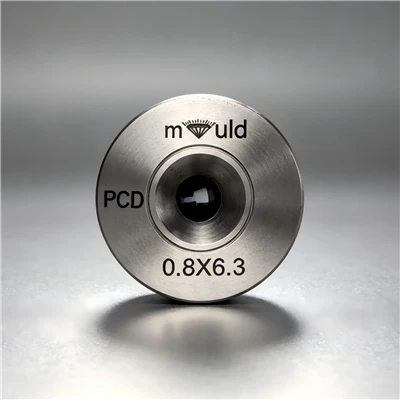
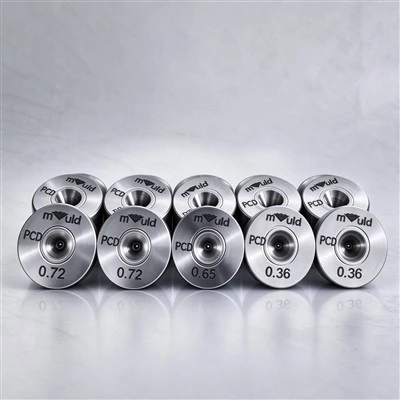
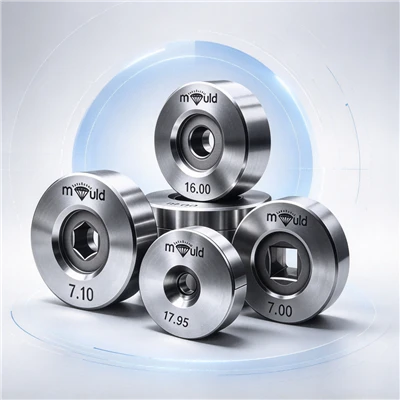
Single Crystal Diamond Wire Drawing Dies
Precision Wire & Cable Processing
Our Single Crystal Diamond Wire Drawing Dies are manufactured with precision-cut natural or synthetic single-crystal diamond and are designed for high-precision metal wire drawing applications.
The diamond working surface provides a highly wear-resistant and smooth drawing interface for controlled diameter reduction. Die hole geometry, polishing condition, bearing length, and dimensional tolerance can be specified according to the wire material, wire diameter, drawing machine, lubrication method, and production requirements.
For applications where wire surface quality, dimensional accuracy, roundness, and bore stability are important, single crystal diamond drawing dies can be manufactured to match the specific drawing process.
Single Crystal Diamond Wire Drawing Die Manufacturer
We manufacture Single Crystal Diamond Wire Drawing Dies for precision wire and cable processing, with die specifications developed around the customer's actual drawing conditions.
A drawing die is not selected only according to the finished wire diameter. The wire material, incoming diameter, reduction per pass, drawing speed, lubrication, cooling, machine configuration, and required tolerance all influence the appropriate die design.
Our manufacturing process includes diamond preparation, die body machining, diamond setting, precision bore machining, grinding, polishing, and dimensional inspection.
For OEM and replacement requirements, customers can provide drawings, existing dies, samples, or production parameters for specification review.
Manufactured According to Your Drawing Process
Typical information used for die selection includes:
| ParameterInformation Required | |
|---|---|
| Wire Material | Copper, aluminum, steel, stainless steel, alloy wire, etc. |
| Incoming Wire Diameter | Diameter before drawing |
| Finished Wire Diameter | Target diameter after drawing |
| Reduction per Pass | Reduction percentage or drawing schedule |
| Drawing Speed | Machine or production line speed |
| Lubrication | Dry drawing, wet drawing, emulsion, oil, etc. |
| Cooling | Cooling method and operating condition |
| Wire Surface | Existing surface condition and required finish |
| Dimensional Tolerance | Required finished wire tolerance |
| Wire Shape | Round or shaped wire |
| Drawing Machine | Machine type and configuration |
| Quantity | Required quantity per specification |
How Single Crystal Diamond Wire Drawing Dies Work
During wire drawing, the metal wire is pulled through a precision die opening. The die reduces the cross-sectional area of the wire while controlling the final diameter and geometry.
A typical diamond drawing die contains several functional areas:
Approach Zone
The approach zone guides the incoming wire into the die and provides a gradual transition into the reduction area.
Its geometry needs to be matched to the wire diameter and drawing conditions to avoid abnormal contact at the die entrance.
Reduction Zone
The reduction zone is where the main cross-sectional reduction takes place.
The angle and profile of this area influence the contact condition between the wire and diamond surface, drawing force, friction, and deformation behavior.
Bearing Zone
The bearing zone controls the final wire diameter as the wire passes through the calibrated section of the die.
Its diameter, length, roundness, and surface finish directly affect dimensional stability and the surface condition of the finished wire.
Exit Zone
The exit zone provides a controlled transition as the drawn wire leaves the die.
Proper finishing of the exit area helps reduce mechanical damage and localized contact at the die outlet.
Single Crystal Diamond Material
Single crystal diamond provides a very hard and wear-resistant working surface for precision wire drawing.
Unlike polycrystalline diamond, which consists of multiple diamond grains, a single crystal diamond working element is formed from one continuous diamond crystal. This structure can provide a highly uniform working surface when the diamond is properly cut, oriented, ground, and polished.
For precision wire drawing, the condition of the diamond bore is particularly important because the wire continuously contacts the working surface during production.
Key Material Characteristics
High Hardness
Diamond has extremely high hardness, making it suitable for applications involving continuous contact and abrasive wear during wire drawing.
Low Surface Roughness After Precision Polishing
A properly polished diamond bore provides a smooth contact surface between the wire and die. This is important for applications where scratches, drawing marks, and surface defects must be controlled.
Dimensional Stability
The wear resistance of the diamond working surface helps maintain the bore geometry under suitable drawing conditions.
Actual die performance depends on wire material, drawing speed, reduction, lubrication, cooling, alignment, and other production parameters.
Precision Finishing Capability
The diamond bore can be precision ground and polished according to the required wire diameter, tolerance, and surface requirements.
Single Crystal Diamond vs. PCD Wire Drawing Dies
Single crystal diamond and PCD drawing dies are both used in wire drawing, but their diamond structures and typical application requirements are different.
| FeatureSingle Crystal DiamondPCD | ||
|---|---|---|
| Diamond Structure | Single continuous crystal | Polycrystalline diamond |
| Working Surface | Highly uniform crystal surface | Multi-grain diamond structure |
| Typical Focus | Precision and surface finish | Wear resistance and continuous production |
| Bore Finishing | Precision grinding and polishing | Precision grinding and polishing |
| Application | Fine and precision wire | Continuous industrial wire drawing |
| Selection | Based on wire and process requirements | Based on wire and process requirements |
The appropriate die depends on the actual production process rather than the material name alone.
For precision wire applications where bore finish and dimensional control are critical, single crystal diamond can be considered. For demanding continuous production environments, PCD may be selected according to the wire material, production speed, and required service performance.
Wire Materials
Single Crystal Diamond Wire Drawing Dies can be used for a range of non-ferrous and selected metal wire drawing applications.
Typical materials include:
Copper wire
Aluminum wire
Copper alloy wire
Aluminum alloy wire
Fine metal wire
Electrical conductor wire
Enamelled wire
Bonding wire
Specialty wire
Precision wire
The die specification should be selected according to the material's hardness, ductility, work-hardening behavior, incoming diameter, target diameter, and drawing conditions.
For very fine wire, the bore diameter, roundness, surface finish, and alignment become increasingly important because small dimensional changes can directly affect the finished wire.
Applications of Single Crystal Diamond Wire Drawing Dies
01 / Fine Wire Drawing
They can be used for fine metal wire where tight diameter control and a smooth wire surface are required.
The die bore can be precision finished according to the target wire diameter and tolerance.
02 / Copper Wire Drawing
Copper wire drawing applications require controlled diameter reduction and surface quality, particularly for electrical and electronic applications.
Diamond dies can be used in precision drawing processes where bore finish and dimensional stability are important.
03 / Aluminum Wire Drawing
Aluminum and aluminum alloy wires can be drawn through diamond dies according to the required reduction schedule, lubrication conditions, and finished wire specifications.
04 / Bonding Wire
Bonding wire production requires precise control of wire diameter and surface condition. Single crystal diamond dies can be specified for fine wire drawing processes according to the material and target dimensions.
05 / Electrical and Cable Wire
Diamond drawing dies can be used for precision processing of conductive wire used in electrical and cable applications where consistent diameter and surface condition are required.
06 / Specialty Wire
For specialty metal wires with specific dimensional or surface requirements, the die geometry and polishing condition can be developed according to the production process.
Key Parameters for Single Crystal Diamond Die Selection
Selecting a diamond wire drawing die requires consideration of the complete drawing process.
| ParameterInfluence on Die Selection | |
|---|---|
| Wire Material | Determines material compatibility, die design, and working conditions |
| Incoming Diameter | Defines the initial die entry and reduction requirements |
| Finished Diameter | Determines the final bearing diameter |
| Reduction per Pass | Influences reduction-zone geometry and drawing force |
| Drawing Speed | Affects friction, heat generation, and die wear |
| Lubrication | Influences friction and contact conditions |
| Cooling | Helps control wire and die temperature |
| Wire Surface | Affects friction, wear, and finished surface quality |
| Dimensional Tolerance | Determines required bore accuracy |
| Roundness | Influences the required bore geometry and inspection |
| Drawing Machine | Affects alignment and operating conditions |
| Production Volume | Helps determine the appropriate die material and specification |
Precision Diamond Bore Finishing
The bore is one of the most important functional areas of a wire drawing die.
Our manufacturing process focuses on the internal bore geometry and surface condition because the bore directly contacts the wire during drawing.
The finishing process can include:
Bore Machining → Precision Grinding → Fine Polishing → Bore Measurement → Roundness Inspection → Final Inspection
The required finishing condition can be adjusted according to the customer's wire material, finished diameter, drawing speed, and surface requirements.
For precision applications, bore diameter and roundness should be controlled according to the required finished wire tolerance rather than using a universal specification.
Manufacturing Process
The manufacturing process for Single Crystal Diamond Wire Drawing Dies generally includes:
1. Material Preparation
The diamond working material and supporting die body are prepared according to the required die specification.
2. Die Body Machining
The supporting body is machined to the required external dimensions and assembly configuration.
3. Diamond Setting
The single crystal diamond is accurately positioned and secured within the die body.
4. Bore Formation
The die opening is formed according to the specified wire diameter and bore profile.
5. Precision Grinding
The bore is ground to achieve the required geometry and dimensional accuracy.
6. Polishing
The working surface is polished to reduce surface roughness and provide a smooth contact surface for the wire.
7. Dimensional Inspection
The finished die is inspected according to the specified bore diameter, roundness, geometry, and surface requirements.
8. Final Inspection
The finished die is checked against the agreed technical specification before shipment.
Custom Single Crystal Diamond Wire Drawing Dies
We manufacture custom diamond drawing dies according to customer drawings, samples, existing die specifications, or wire production requirements.
Custom manufacturing is available for different wire diameters, wire materials, bore geometries, tolerances, and application conditions.
For replacement dies, customers can provide the existing die specification together with information about the current production problem.
For example:
Finished wire diameter gradually increasing
Wire surface scratches
Increased drawing force
Short die service life
Bore wear
Dimensional instability
Wire roundness problems
This information helps determine whether the replacement die specification, bore condition, lubrication, alignment, or other drawing parameters require adjustment.
Quality Inspection
For precision wire drawing dies, dimensional inspection focuses on the working bore rather than only the external dimensions of the die.
Inspection can include:
Bore diameter
Bore roundness
Bore geometry
Bearing section
Surface finish
Diamond condition
Die body dimensions
Concentricity
Visual inspection
Inspection requirements can be agreed according to the application and customer's technical specification.
Single Crystal Diamond Wire Drawing Die Manufacturer
We manufacture wire drawing dies for industrial customers requiring controlled dimensional performance and precision bore finishing.
Our manufacturing capabilities cover diamond dies, carbide wire drawing dies, shaped wire drawing dies, extrusion dies, shaving dies, nail dies, cold heading dies, and other custom carbide tooling.
With more than 60 years of manufacturing experience, our factory operates with approximately 4,000 m² of production space and 280 employees, producing more than 500 specifications across 30 product categories.
For Single Crystal Diamond Wire Drawing Dies, our manufacturing work focuses on the part that directly affects drawing performance: diamond selection, bore geometry, precision finishing, dimensional control, and inspection.
Customers can work with us based on drawings, samples, existing tooling, or production parameters.
How to Request a Quote
To evaluate a Single Crystal Diamond Wire Drawing Die requirement, please provide as much of the following information as available:
Wire material
Incoming wire diameter
Finished wire diameter
Reduction per pass
Drawing speed
Lubrication method
Cooling method
Required dimensional tolerance
Wire surface requirements
Drawing machine information
Required quantity
Existing die drawing or sample
If you are replacing an existing die, providing the current die dimensions and finished wire measurements can also help us determine the required specification.
Send your drawing, sample, or wire drawing parameters for a Single Crystal Diamond Wire Drawing Die quotation.
FAQ
What is a Single Crystal Diamond Wire Drawing Die?
A Single Crystal Diamond Wire Drawing Die uses a single-crystal diamond as the working material around the precision die bore. It is used to reduce metal wire diameter while controlling dimensional accuracy, roundness, and surface condition.
What is the difference between Single Crystal Diamond and PCD dies?
Single crystal diamond uses a continuous diamond crystal as the working element, while PCD consists of multiple diamond grains consolidated into a polycrystalline material. Their structure, finishing characteristics, and typical application requirements are different.
What wire materials can be drawn with diamond dies?
Applications can include copper, aluminum, copper alloys, aluminum alloys, fine metal wires, bonding wire, electrical conductor wire, and other specialty wires. Die selection should be based on the actual wire material and drawing conditions.
How do I select the correct diamond drawing die?
Selection should consider incoming diameter, finished diameter, wire material, reduction per pass, drawing speed, lubrication, cooling, dimensional tolerance, wire surface requirements, and machine configuration.
Can you manufacture custom Single Crystal Diamond Dies?
Yes. Dies can be manufactured according to customer drawings, samples, existing die specifications, or production requirements.
Can you make replacement dies according to an existing die?
Yes. Existing die dimensions, samples, drawings, or finished wire specifications can be used as reference for replacement die manufacturing.
Does drawing speed affect diamond die selection?
Yes. Drawing speed influences friction, heat generation, lubrication requirements, and die wear. The appropriate die specification should therefore be considered together with the complete drawing process.
What information is required for a quotation?
The most useful information includes wire material, incoming diameter, finished diameter, reduction per pass, drawing speed, lubrication, cooling, dimensional tolerance, quantity, and an existing drawing or sample if available.
Hot Tags: single crystal diamond dies, China single crystal diamond dies manufacturers, suppliers, factory