Square Wire Drawing Die Materials
Different die materials are suitable for different drawing conditions.
|
Die Material |
Typical Application |
Main Consideration |
|
Tungsten Carbide (TC) |
Steel, stainless steel, short-to-medium production |
Toughness and cost |
|
PCD |
Copper, aluminum, non-ferrous wire, longer production runs |
Wear resistance and surface finish |
|
SSCD |
Fine and precision shaped wire |
Dimensional and surface requirements |
|
Natural Diamond (ND) |
Fine wire and specialized precision applications |
Fine surface finish and dimensional control |
PCD dies are particularly suitable for non-ferrous wire because their wear resistance can help maintain the shaped profile over longer production runs. Tungsten carbide is commonly used for steel wire and applications where tooling cost and mechanical toughness are important.
Key Parameters for Square Wire Drawing Die
The die should be specified according to the actual wire drawing process rather than only the finished square dimension.
|
Parameter |
Why It Matters |
|
Incoming wire diameter |
Determines the starting cross-section and reduction requirement |
|
Finished square size |
Defines the final die opening |
|
Corner radius |
Controls the geometry of the four corners |
|
Wire material |
Determines die material and forming requirements |
|
Reduction per pass |
Influences die geometry and drawing load |
|
Die angle |
Affects material deformation and contact conditions |
|
Bearing length |
Controls final sizing and profile stability |
|
Dimensional tolerance |
Determines the required machining and polishing accuracy |
|
Drawing speed |
Influences heat generation and die wear |
|
Lubrication |
Affects friction, surface finish and die life |
|
Number of drawing passes |
Determines the overall reduction sequence |
What Is a Square Wire Drawing Die?
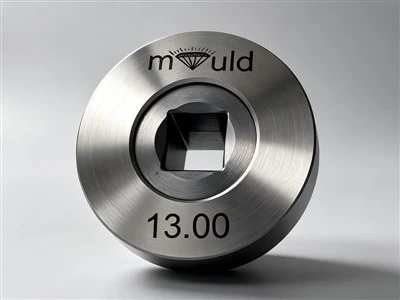
A square wire drawing die is a precision forming tool designed to produce square-section metal wire through a controlled drawing process.
During drawing, the incoming wire passes through a specially profiled die opening. The die applies compressive deformation around the wire while the drawing machine pulls the material through the bearing area. The final cross-section is determined by the geometry of the die opening.
Typical applications include:
Square copper wire
Square aluminum wire
Square stainless steel wire
Square steel wire
Square welding wire
Electrical conductor wire
Transformer winding wire
Motor and alternator wire
Connector and electronic wire
Specialty shaped metal wire
Square and other non-round profiles are commonly produced with shaped drawing dies rather than conventional round dies.

How Square Wire Drawing Dies Work
The drawing process can generally be understood in four stages:
Wire Entry
The incoming wire enters through the approach section of the die. The entry geometry helps guide the wire toward the forming zone.
Cross-Section Reduction
The wire enters the reduction zone, where the die gradually changes the cross-sectional geometry.
For a square die, material flows toward four controlled sides while the corners are formed according to the specified corner radius.
Bearing and Sizing
The bearing section controls the final dimensions of the square wire.
Important parameters include:
Square width
Square height
Corner radius
Bearing length
Die angle
Dimensional tolerance
Concentricity
Wire Exit
The finished square wire leaves the die through the exit section. Proper exit geometry helps reduce unnecessary contact and protects the finished surface.
Square Wire Die Construction
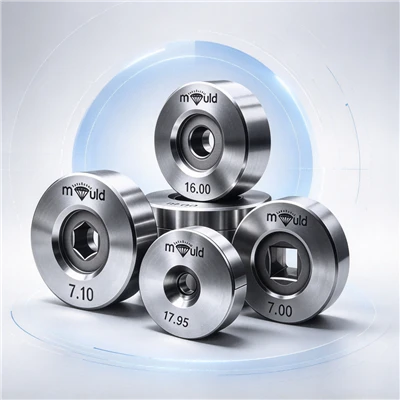
A typical square wire drawing die consists of a die insert or working core and an outer holder/casing.
Working Core
The working core contains the precision-shaped square opening. Its material is selected according to the wire material and production conditions.
Die Casing
Lorem ipsum dolor sit amet consectetur adipisicing elit.
Square Die Opening
The opening determines the finished wire profile. The design normally considers:
Width and height
Corner radius
Reduction angle
Bearing length
Entrance and exit geometry
Required dimensional tolerance
For custom shaped dies, manufacturers can engineer the die geometry according to the customer's finished wire dimensions and drawing process. Commercial shaped-die specifications commonly include die angle, tolerance, blank material and minimum size as design parameters.
Square Wire Die Size and Tolerance
They are normally customized because the required dimensions vary significantly between applications.
For example, a specification may include:
Finished Wire: 2.00 × 2.00 mm
Corner Radius: R0.10 mm
Wire Material: Copper
Die Material: PCD
Required Tolerance: ±0.01 mm
The actual die specification should be determined from the customer's drawing process and finished wire requirements.
For high-precision applications, tighter tolerances may be available depending on die material, profile size, machining method and inspection capability. Published shaped-die specifications show that tolerances around ±0.015 mm can be offered for standard configurations, with tighter tolerances available according to requirements.
Round Wire to Square Wire Drawing
Square dies can be incorporated into a multi-pass drawing sequence when the incoming material is round.
A typical process may be:
Round Rod → Round Drawing → Intermediate Profile → Square Shaping → Final Square Wire
The exact sequence depends on:
Starting diameter
Finished square dimension
Wire material
Total area reduction
Reduction per pass
Corner radius
Drawing machine capacity
For large cross-section changes, attempting to obtain the final square geometry in a single pass may not be appropriate. A staged reduction sequence can provide better control over deformation and final dimensions.
Applications of Square Wire Drawing Dies
Electrical Wire
Square copper and aluminum wires can be used where the conductor geometry needs to fit a specific winding or electrical design.
01
Transformer Winding Wire
Square and rectangular copper conductors are used in certain transformer winding configurations where conductor packing and cross-sectional utilization are important. Shaped diamond dies are also used for transformer winding wire applications.
02
Motor and Automotive Wire
Square or shaped copper conductors can be processed for motors, alternators and other electrical components.
03
Connector and Electronic Components
Precision-shaped copper wires can be used for connector pins and other electronic components. Shaped diamond dies are documented for connector pin and flat cable applications.
04
Steel and Stainless Steel Wire
Tungsten carbide shaped dies can be used for steel and stainless steel wire where the required profile is square or another non-round geometry.
05
How to Select the Right Square Wire Drawing Die
Before ordering a square wire drawing die, provide the following information:
1. Wire Material
Specify whether the wire is:
- Copper
- Aluminum
- Steel
- Stainless steel
- Welding wire
- Other alloy
2. Incoming Wire Size
Provide the diameter or cross-sectional dimensions before drawing.
3. Finished Wire Size
For square wire, provide:
Width × Height + Corner Radius
For example:
2.50 × 2.50 mm, R0.15 mm
4. Required Tolerance
Specify the dimensional tolerance of the finished wire.
5. Drawing Machine
Machine type and drawing configuration can affect die dimensions and installation requirements.
6. Drawing Speed
Higher drawing speeds may increase frictional heating and require appropriate die material, lubrication and profile design.
7. Production Volume
For long production runs, PCD may be considered for non-ferrous applications. For short runs or certain ferrous applications, tungsten carbide can be a practical option.
What materials can be drawn with square wire dies?
Square dies can be designed for copper, aluminum, steel, stainless steel and other metal wires. The appropriate die material depends on the workpiece material and drawing conditions.
FAQ
Q: What is the best material for a square wire drawing die?
A: There is no single material that is best for every application. PCD is commonly considered for long-run non-ferrous wire drawing, while tungsten carbide is commonly used for steel and other applications where toughness and tooling cost are important.
Q: Can a square die be customized?
A: Yes. Square dies can be customized according to finished wire dimensions, corner radius, tolerance, die material and drawing-machine requirements.
Q: Can round wire be drawn into square wire?
A: Yes. A shaped drawing die can transform a round or intermediate-profile wire into a square profile. The number of drawing passes should be determined according to the material and required reduction.
Hot Tags: square wire drawing dies, China square wire drawing dies manufacturers, suppliers, factory