

Match the Die to the Forging Method
Tungsten carbide hot forging dies behave differently under a press, a hammer and an upsetter. Buying on grade name alone ignores the load pattern that actually determines die life.
Press forging
Sustained pressure with long dwell time. The cavity is loaded in compression for the full stroke, so the priority is compressive strength and resistance to plastic deformation. A 15–20% cobalt grade with medium grain holds its shape where H13 cavities gradually sink.
Hammer forging
Repeated impact with short contact. Toughness matters more than peak hardness: a 20–25% cobalt grade in a prestressed holder survives the shock that would chip a harder insert. The holder is not an accessory here - it is part of the die system.
Upsetting and heading
High radial load on a small cavity. The insert must be fully supported by the holder, with no room to flex. We specify interference fits and limit cavity depth accordingly, even if a deeper cavity would look more economical on paper.
Warm forging
Lower billet temperature reduces thermal shock. A 12–15% cobalt grade gives a better balance of wear resistance and toughness, and often extends life further than moving to the highest-toughness grade.
What Heat Actually Does to Die Materials
The reason carbide replaces tool steel in hot forging is not room-temperature hardness. It is what happens to that hardness when the die is working.
| Property at temperature | WC-Co carbide | H13 tool steel |
| Hardness at 20 °C | HRA 82–86 | HRC 44–52 |
| Hardness at 600 °C | Largely retained | Falls sharply |
| Thermal conductivity | 60–100 W/mK | Around 25 W/mK |
| Thermal expansion | 5–7 ×10⁻⁶/K | Around 12 ×10⁻⁶/K |
Higher conductivity pulls heat out of the surface faster; lower expansion means less dimensional movement as the die heats. Together they reduce the temperature gradient that drives thermal fatigue.
Heat still has to be managed on the line. Preheat the die before the first billet - a cold carbide insert struck by hot material will crack whatever its grade. Use a graphite-based or glass-coat lubricant matched to the billet temperature, and keep the die-change interval consistent so each insert sees a similar thermal cycle.
Insert Systems Built for Long Runs
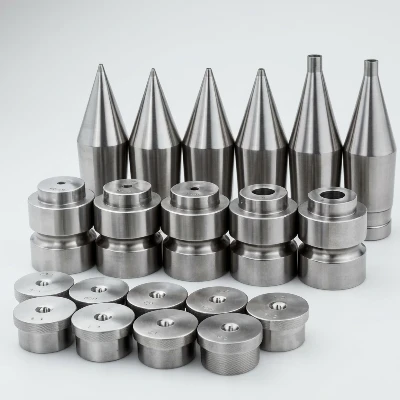
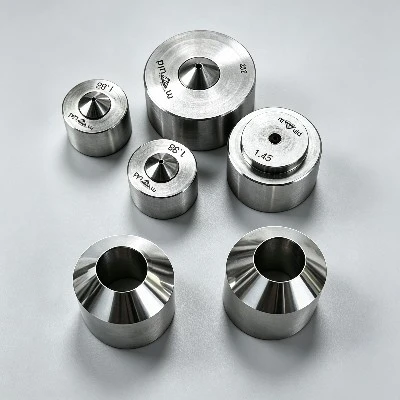
Our tungsten carbide hot forging dies are supplied as complete systems, not as bare nibs that leave the buyer to solve the fitting problem.
Holder and fit
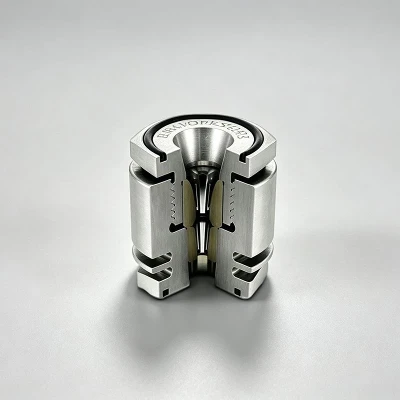
Each insert is matched to a tool steel holder with a controlled interference fit. The holder absorbs shock and locates the die; the insert does the forming. We supply the holder with the insert or machine to your existing holder drawing - either way, the fit is documented.
Cavity finish
cavities are machined by EDM and wire cutting, then ground and polished. The recast layer left by EDM is removed before the die ships, because it is the most common starting point for heat cracks in service.
Reconditioning path
Worn cavities can be ground back and re-polished, in many cases more than once. We supply the reconditioning sequence with the die, so you know the limits before you need them rather than after.
Inspection record
Cavity dimensions against the CAD model, hardness, density, binder verification and ultrasonic screening are documented for every die. The report ships with the tooling, not on request.
FAQ
Q: Can you convert my existing H13 die design to carbide? Yes. Send the die drawing and the forging method. We review radii, cavity depth and holder support - the three details that most often need changing when moving from steel to carbide - and confirm the changes before machining.
Q: What preheat temperature do you recommend? It depends on billet material and die size, but most hot forging inserts should be preheated before the first stroke. We supply a specific target with each die set. Skipping preheat is the fastest way to destroy a carbide insert.
Q: How many forgings can I expect per die? It depends on part geometry, billet temperature and lubricant, so we quote a range based on your conditions rather than a universal number. We confirm it against your first production batch and track it from there.
Q: Do you supply the holder with the insert? Yes, or we machine the insert to your existing holder drawing. Either way the interference fit and seating are specified and recorded, because a poorly supported insert will fail early regardless of grade.
Q: Can a worn hot forging cavity be reconditioned? In most cases yes - grinding and re-polishing restore the working surface, and some cavities can be re-cut. We include the reconditioning limits with the original die so you can plan for it.
Hot Tags: tungsten carbide hot forging dies, China tungsten carbide hot forging dies manufacturers, suppliers, factory, Carbide Dies For Wire Drawing, Carbide Drawing Die, Carbide Wire Drawing Dies, Tungsten Carbide Dies for Steel Wire Drawing, Tungsten Carbide Dies Hard Metal, Tungsten Carbide Drawing Dies