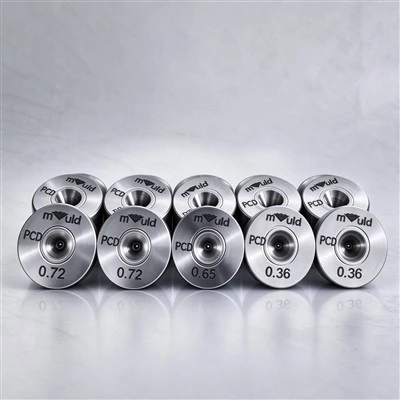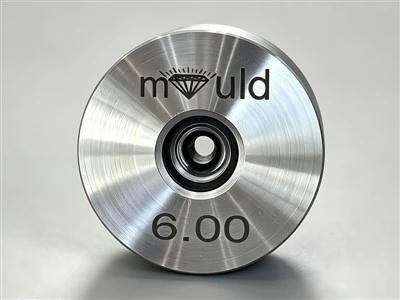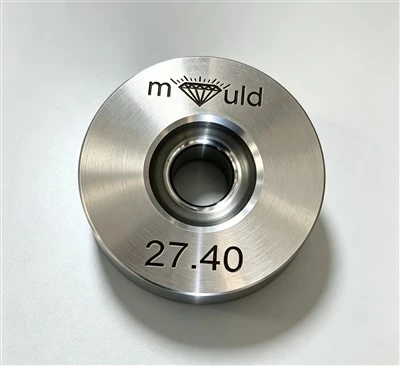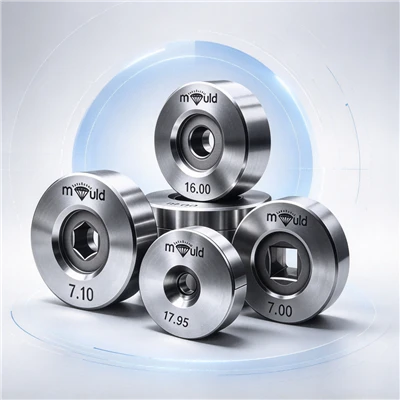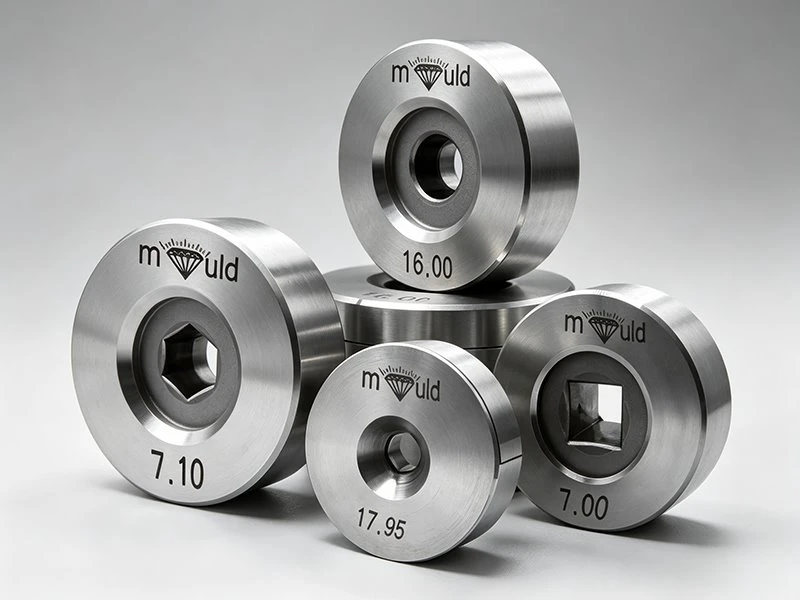
The primary function of a Tungsten Carbide Drawing Die is to control the cross-sectional reduction and final diameter of wire during continuous drawing. The wire is pulled through the carbide bore, while the reduction zone applies compressive deformation and the bearing controls the finished diameter.
Die Structure
A typical Tungsten Carbide Drawing Die contains:
Tungsten carbide insert - main working component
Entry zone - guides the incoming wire
Reduction zone - controls diameter reduction
Bearing - establishes final wire size
Exit zone - guides the drawn wire out of the die
Metal holder - supports and protects the carbide insert
The bearing is the most important dimensional section. Progressive bearing wear increases the effective bore size and can cause the finished wire diameter to gradually exceed the specified tolerance.

Tungsten Carbide Material
The working insert is manufactured from cemented tungsten carbide, generally consisting of tungsten carbide particles bonded with a metallic binder such as cobalt. Different carbide grades provide different combinations of hardness, toughness, and wear resistance.
Material selection should consider wire hardness, tensile strength, surface condition, reduction per pass, drawing speed, and lubrication. A harder carbide grade may improve wear resistance, while a tougher grade may be more suitable where impact or mechanical loading is significant.
Manufacturing Process
Typical manufacturing includes carbide powder preparation, pressing or forming, sintering, precision bore machining, bearing grinding, polishing, inspection, and holder assembly.
The critical dimensions include bore diameter, bearing length, reduction angle, surface finish, roundness, and concentricity. For precision wire drawing, the finished bore must be inspected because dimensional errors in the bearing can directly affect wire diameter and ovality.
Applications
They can be used for steel wire, stainless steel wire, copper wire, aluminum wire, brass wire, and other metal wires, with the specific carbide grade and die geometry selected according to the material.
A typical production process is:
Wire Rod → Pre-Treatment → Rough Drawing → Intermediate Drawing → Fine Drawing → Diameter Inspection → Take-Up
Carbide dies are commonly integrated into the earlier or intermediate drawing stages, although they can also be used for fine drawing when the wire material, diameter, tolerance, and operating conditions are appropriate.
Operating Conditions
During operation, the die is subjected to radial contact pressure, drawing tension, sliding friction, and friction-generated heat. The actual drawing force is affected by the wire material, cross-sectional reduction, die angle, friction coefficient, drawing speed, and lubrication.
For production control, engineers should monitor drawing speed, drawing tension, lubricant temperature, lubricant flow, finished-wire diameter, and die temperature where applicable. Increasing drawing speed without sufficient lubrication can increase frictional heating and accelerate carbide-bore wear.
Lubrication
Lubrication reduces friction between the wire and carbide bearing and helps control heat generated during drawing. Depending on the wire and process, manufacturers may use dry drawing powder, oil-based lubricant, or water-based drawing fluid.
Lubricant contamination is an important wear factor. Metal particles, oxides, or abrasive debris entering the die can scratch the bearing and accelerate bore enlargement. Continuous drawing systems should therefore maintain appropriate lubricant filtration, circulation, temperature, and concentration.
Common Failure Modes
Typical failure modes include:
|
Failure Mode |
Observable Result |
|
Bearing wear |
Finished wire diameter gradually increases |
|
Uneven wear |
Increased wire ovality |
|
Bearing scratching |
Longitudinal scratches on wire |
|
Carbide cracking |
Sudden dimensional change or die damage |
|
Edge chipping |
Abnormal wire surface or unstable drawing |
|
Excessive thermal wear |
Accelerated bore deterioration |
|
Misalignment |
One-sided bearing wear |
FAQ
Q: What information is required to select a Tungsten Carbide Drawing Die?
A: The basic selection data includes wire material, incoming diameter, finished diameter, diameter tolerance, reduction per pass, drawing speed, lubrication method, and die-holder dimensions. For steel or stainless steel wire, the wire hardness and tensile strength should also be provided because they directly affect drawing load and carbide wear.
Q: What wire materials can be drawn with Tungsten Carbide Dies?
A: They can be used for steel, stainless steel, copper, aluminum, brass, and other metal wires. The carbide grade and die geometry should be selected according to wire hardness, diameter, reduction ratio, drawing speed, and surface condition.
Q: How long does a Tungsten Carbide Drawing Die last?
A: Die life varies with wire material, reduction per pass, drawing speed, lubrication, incoming wire surface, carbide grade, and alignment. For production evaluation, it is more useful to record meters of wire drawn, bore wear, and finished-wire diameter stability rather than defining service life only in operating hours.
Q: What causes premature wear of Tungsten Carbide Drawing Dies?
A: Common causes include insufficient lubrication, contaminated lubricant, excessive reduction per pass, high drawing speed, abrasive particles, incorrect carbide grade, and die misalignment. A gradual increase in finished-wire diameter is a typical indication of bearing wear.
Hot Tags: tungsten carbide drawing dies, China tungsten carbide drawing dies manufacturers, suppliers, factory