


Advantages
|
Advantage |
What it means for your mill |
|
Longer campaign life |
Carbide rings typically deliver 7–9× the life of cast-iron rolls (groove life often reported 10–20×, total rolling volume 20–40× in composite-ring setups). Fewer ring changes, less downtime. |
|
Stable groove geometry |
Holds pass dimensions to the final stand, so gauge and profile stay consistent across the whole campaign. |
|
Lower cost per ton |
Higher purchase price is offset by fewer changeovers, less grinding labor, and higher yield - the effective cost per ton rolled drops sharply at volume. |
|
Superior surface finish |
High rigidity (2–3× steel) and red hardness (stable to ~500–800 °C) keep the rolled product clean and defect-free. |
|
Groove retention under thermal cycling |
Resists the heat-checking micro-cracks that force early regrinds in conventional rolls. |
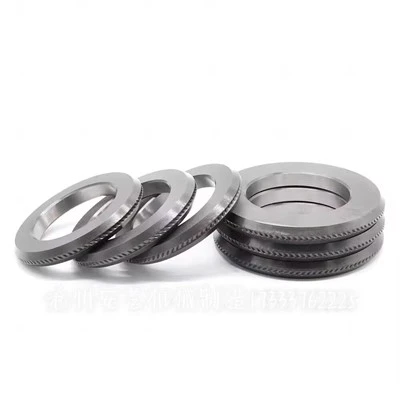
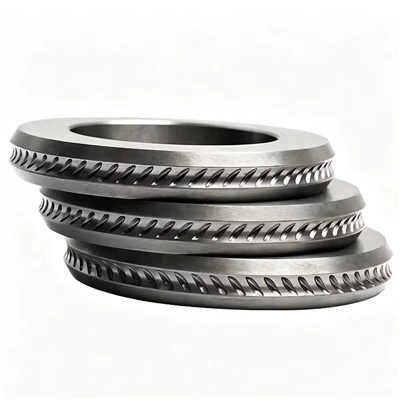
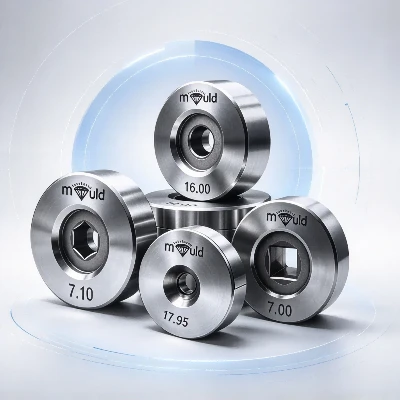
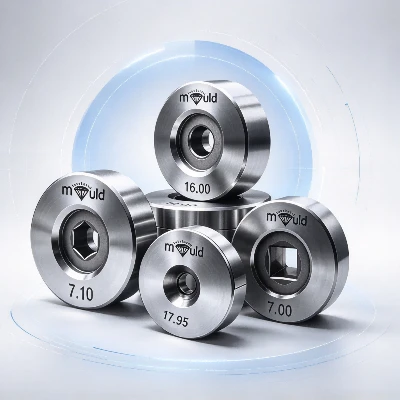
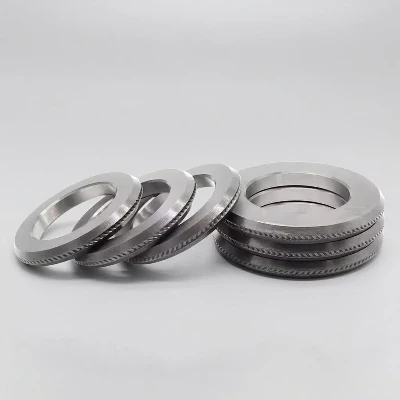
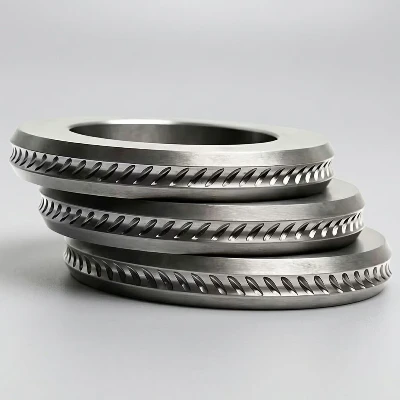
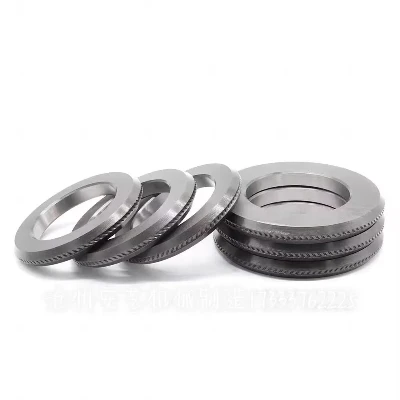
Carbide roll rings - the working ring alone, supplied grooved or plain, to your OD / ID / groove profile.
Composite rolls - a precision-ground carbide ring mounted on a reusable alloy-steel arbor (shrink-fit or mechanical clamp). Replace only the worn ring; the shaft stays in service.
Kocks 3-roll rings - for 3-high mills, replacing ductile cast-iron rings.
Cassette / cold-rolling rolls - for cold rolling lines and cold-rolled ribbed bar.
Pinch & guide rolls - wire head feeding the laying head; guide and stress-relieving roles in the line.
Typical supply range: OD 120–470 mm · ID 70–310 mm · height 40–250 mm, custom to drawing. Rings are machined to your existing profile so they drop into current stands without re-tooling.
Where They Are Used
|
Mill / product |
Role of carbide wire rolls |
|
High-speed wire rod mill |
Finishing & block stands, final sizing |
|
Rebar / TMT bar mill |
Pre-finishing & finishing, ribbed profile |
|
Bar & section mill |
Finishing stands, stable groove geometry |
|
Seamless tube mill |
Sizing & finishing, wall-thickness control |
|
3-roll Kocks / stretch-reducing mill |
Replacing ductile cast-iron rings |
Why Us- Manufacturing Credentials
Since 1962 - six decades of carbide and hard-alloy manufacturing experience.
ISO-certified quality system (confirm current certificate version).
Export-proven - supplied to Singapore, Malaysia, Indonesia, and Hong Kong, with sales-service offices in Guangdong, Fujian, and Zhejiang.
Custom & OEM - produced to your drawing; grade, inspection scope, and production route stated in the quotation.
100% inspection - dimensional, balance, and ultrasonic checks where agreed; mill test certificate per roll.
Full support - stand-by-stand grade recommendation, regrind scheduling, and matched replacement rings.

FAQ:
1. What is the difference between a carbide roll ring and a composite roll?
A roll ring is the carbide working ring alone. A composite roll is that ring mounted on a reusable steel arbor - replace only the worn ring, cutting cost and downtime.
2. How long do carbide wire rolls last vs cast iron?
Commonly 7–9× the campaign life, with groove life reported at 10–20× and total rolling volume 20–40× in composite-ring configurations.
3. Can they replace our current rolls without changing the mill?
Yes. Rings are machined to your existing OD / ID / groove profile and mount via shrink-fit or mechanical clamp, with no re-tooling.
4. What sizes can you supply?
Standard supply covers OD 120–470 mm, ID 70–310 mm, height 40–250 mm, custom to drawing.
5. When should we NOT use carbide rolls?
Avoid carbide in roughing stands (impact too high) and in very low-volume lines where the longer campaign cannot offset the higher purchase price.
Hot Tags: tungsten carbide wire rolls, China tungsten carbide wire rolls manufacturers, suppliers, factory, Carbide Wire Rolling Rolls, grooved carbide rolls, Tungsten Carbide Rolling Rolls, tungsten carbide rolls, Tungsten Carbide Wire Rolling Rolls, Tungsten Carbide Wire Rolls