


|
Observable Condition |
Possible Cause |
Inspection Point |
|
Wire diameter gradually increases |
Bearing wear |
Measure bore and finished-wire diameter |
|
Longitudinal scratches |
Damaged bearing or contamination |
Inspect die bore and lubricant |
|
Wire ovality increases |
Misalignment or uneven bearing wear |
Check die alignment and bearing geometry |
|
Die develops edge damage |
Excessive mechanical impact or improper installation |
Inspect die seating and wire entry |
|
Drawing temperature rises |
High friction or insufficient lubrication |
Check lubricant flow and temperature |
|
Die life decreases suddenly |
Abrasive contamination or abnormal wire condition |
Check lubricant filtration and incoming wire |
How Diamond Drawing Dies Work
During wire drawing, the incoming wire enters the die through the approach cone, where the cross-sectional area is progressively reduced. The wire then passes through the bearing zone, which establishes the final diameter, before leaving through the exit cone. The drawing force generated by the capstan or drawing block pulls the wire through the die while the die absorbs the radial contact load.
For example, when a metal wire is reduced from 1.00 mm to 0.80 mm, the cross-sectional area reduction is approximately 36%.
In production, the total reduction is normally distributed over multiple drawing passes rather than forcing the entire diameter reduction through one die. This reduces the drawing force per pass and limits heat generation at the bearing surface.
Diamond Die Structure
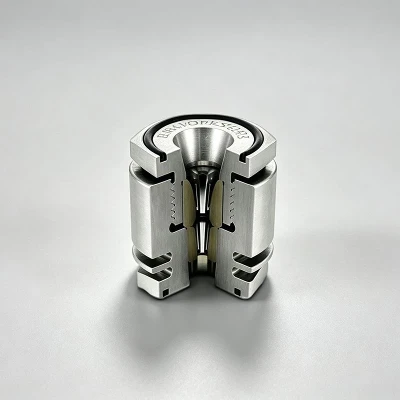
A typical diamond wire drawing die contains four functional geometric zones: the entry zone, reduction zone, bearing zone, and exit zone. The reduction zone determines how the wire transitions toward the final diameter, while the bearing zone provides the calibrated surface that directly controls finished-wire dimensions.
The bearing length is particularly important for dimensional stability and die life. A bearing that is too short may produce unstable diameter control, while excessive bearing length increases contact area and friction. The exact geometry should therefore be selected according to wire diameter, material, reduction ratio, lubrication, and drawing speed rather than using one fixed geometry for all applications.
Diamond Material and Manufacturing
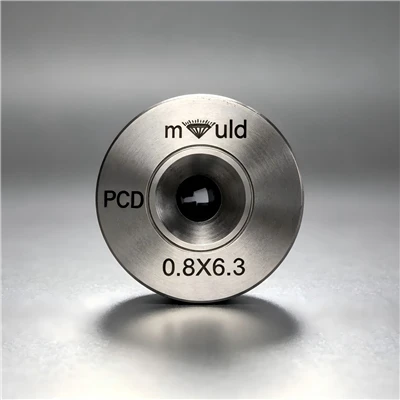
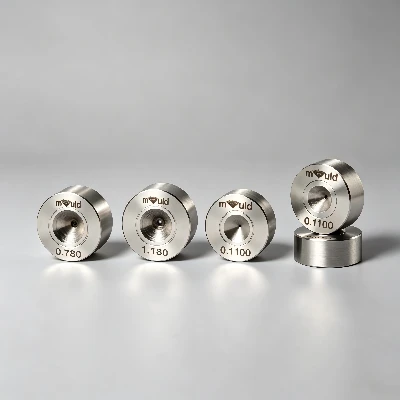
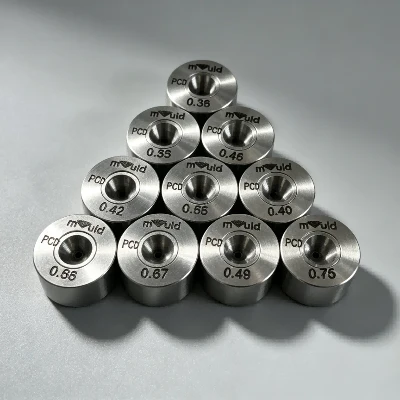
The diamond working element provides high hardness and resistance to abrasive wear. Natural diamond is commonly selected for applications requiring precise small-diameter bores and stable surface characteristics, while polycrystalline diamond (PCD) uses a diamond-grain structure bonded into a consolidated material and is available in configurations suitable for continuous industrial wire drawing.
Manufacturing normally involves diamond blank preparation, precision drilling or laser processing of the die hole, shaping of the approach and exit geometry, bearing finishing, polishing, inspection, and mounting into a metal holder. The final bore must be inspected for diameter, roundness, surface condition, and geometry because defects in the bearing can transfer directly to the drawn wire.
Wire Materials and Industrial Applications
Diamond dies can be used for drawing materials such as copper, aluminum, gold, silver, brass and other non-ferrous wires, particularly where dimensional control and surface finish are important. The selected die material must correspond to the hardness, ductility and abrasive characteristics of the incoming wire.
A typical copper-wire production sequence is:
Rod → coarse drawing → intermediate drawing → fine drawing → final sizing → inspection → winding
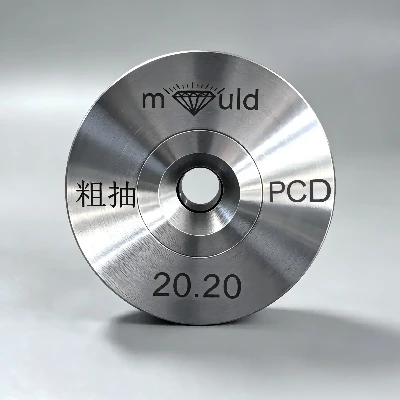
As the wire diameter decreases, the drawing die bore also decreases. In fine-wire production, several dies may be installed sequentially on one drawing machine, with each die performing a controlled reduction before the wire reaches the final diameter.
Drawing Conditions That Affect Die Selection
Die selection is affected by incoming wire diameter, target diameter, reduction per pass, drawing speed, lubrication, wire material and cooling conditions. These variables determine the contact pressure and heat generated in the bearing area.
For example, increasing drawing speed increases the rate of frictional heat generation. If lubrication is insufficient, the temperature of the wire-die interface can rise, increasing surface damage and accelerating die wear. In production, operators should therefore monitor wire speed, lubricant temperature, lubricant concentration or viscosity, drawing tension and finished-wire diameter rather than evaluating die performance only by total operating hours.
Lubrication and Cooling
Lubrication forms a separating film between the wire and the diamond bearing, reducing direct metal-to-diamond contact and controlling friction. Depending on the drawing process, manufacturers may use dry lubricants, oil-based lubricants or water-based drawing fluids.
The lubrication system should maintain a stable supply around the die entry zone. Contamination by metal particles can act as an abrasive and damage the die bearing. For this reason, industrial drawing lines commonly combine lubricant circulation with filtration, temperature monitoring and periodic fluid replacement. The actual lubricant temperature and viscosity limits should follow the drawing-machine and lubricant manufacturer's specifications.
Diamond Dies vs. Carbide Drawing Dies
Diamond dies are generally selected when the process requires high dimensional precision, low bore wear or a fine surface finish, while carbide dies are commonly used for applications involving larger wire sizes or conditions where the lower initial die cost is more important.
The difference becomes more significant during long production runs. If two dies are used under the same wire material, reduction and lubrication conditions, the die with lower bearing wear will maintain its bore geometry for a longer production interval. However, diamond dies are not automatically suitable for every wire-drawing operation; selection should consider wire material, diameter range, drawing force, production speed and expected die life.
Die Bore and Finished Wire Diameter
The die bore is the critical dimensional feature because it directly influences the final wire diameter. A drawing die specified for a nominal finished diameter of 0.500 mm, for example, must be manufactured and inspected according to the required dimensional tolerance rather than simply being identified by the nominal 0.500 mm value.
When selecting a replacement die, the purchaser should provide the incoming wire diameter, finished diameter, wire material, number of drawing passes, reduction per pass, drawing speed, lubricant type and required diameter tolerance. These parameters allow the die manufacturer to determine the appropriate bore size and bearing geometry.
Quality Inspection
Inspection of a diamond drawing die should cover both dimensional accuracy and surface condition. Typical inspection points include bore diameter, bore roundness, bearing length, approach angle, exit geometry, polishing quality and concentricity between the diamond insert and holder.
The finished die should also be checked for visible defects such as chipping, cracks, scratches, irregular bearing surfaces or edge damage. After installation, the actual wire should be measured using appropriate dimensional equipment. If the die nominal size is correct but the drawn wire shows abnormal diameter variation or surface scoring, the cause may be related to die alignment, lubrication, incoming wire condition or contamination rather than the bore diameter alone.
Installation and Die Alignment
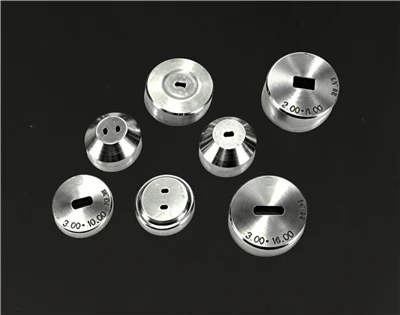
The drawing die must be correctly seated and aligned with the wire path. The die holder should provide stable mechanical support without applying excessive local stress to the diamond insert. The wire must enter the die concentrically to prevent uneven loading of the bearing.
During die replacement, operators should inspect the holder, die seat, wire guide, lubricant supply and upstream wire condition before starting production. After installation, the first production section should be checked for wire diameter, ovality and surface condition. Abnormal wear concentrated on one side of the bearing is an observable indication that alignment or wire entry may require correction.
Common Failure Conditions
Premature diamond-die failure can result from wire misalignment, excessive reduction per pass, insufficient lubrication, contaminated lubricant, excessive drawing speed, incorrect bore geometry or damaged incoming wire.
How to Select Diamond Dies for Wire Drawing
The selection process should begin with the wire material and incoming diameter, followed by the required finished diameter and reduction schedule. The manufacturer then evaluates the appropriate diamond type, bore geometry, bearing length and holder configuration.
For an RFQ, a technically useful specification should include:
Wire material: copper, aluminum, brass, etc.
Incoming wire diameter
Finished wire diameter
Diameter tolerance
Reduction per pass
Number of drawing passes
Drawing speed
Lubrication method
Required surface finish
Machine/die-holder dimensions
Expected production quantity or die-life requirement
Providing these parameters allows the die manufacturer to design or recommend a die based on the actual drawing conditions instead of supplying a die based only on the final wire diameter.

Application
A typical industrial application follows this sequence:
1. Wire preparation → 2. Die specification → 3. Die installation → 4. Lubricant supply → 5. Wire threading → 6. Controlled drawing → 7. Diameter and surface inspection → 8. Die inspection → 9. Die replacement or reconditioning
During production, the key measurable indicators are finished-wire diameter, ovality, drawing tension, drawing speed, lubricant condition and die-bore wear. Recording these parameters over successive production batches allows the operator to determine whether diameter drift originates from die wear, process conditions or upstream wire variation.
Technical Summary
They are precision forming components in which the diamond working element, bore geometry, bearing section and holder structure jointly determine the dimensional and surface characteristics of the drawn wire. Their performance depends not only on diamond hardness but also on die geometry, wire material, reduction schedule, lubrication, alignment and drawing conditions.
For procurement, the most important parameters are therefore not simply "diamond die" and the target diameter. A complete technical specification should define wire material, inlet diameter, outlet diameter, reduction per pass, drawing speed, lubrication conditions, dimensional tolerance and machine interface. This information provides the basis for selecting the diamond type and bore geometry for a specific wire-drawing process.
FAQ
Q: What are Diamond Dies for Wire Drawing used for?
A: They are used to reduce the diameter of metal wire through controlled drawing. Typical applications include copper, aluminum, brass and other non-ferrous wires, especially where small diameters, controlled tolerances and a consistent surface are required.
Q: What is the difference between Natural Diamond and PCD Drawing Dies?
A: Natural diamond uses a single natural diamond working element, while PCD uses a consolidated polycrystalline diamond structure. The choice depends on wire diameter, material, production conditions, required dimensional stability and expected wear behavior.
Q: How does the die bore affect wire diameter?
A: The bearing section of the die establishes the final wire dimension. If the bearing wears, the effective bore increases and the finished wire diameter can gradually move above the target value. Therefore, finished-wire diameter should be monitored during production rather than relying only on the original die specification.
Q: Why does a Diamond Drawing Die produce scratches on the wire?
A: Possible causes include scratches or defects in the bearing, metal particles trapped in the lubricant, damaged incoming wire, insufficient lubrication or incorrect die alignment. The die bore and lubrication system should be inspected before increasing drawing tension or replacing process parameters.
Q: What information is required to order a Diamond Drawing Die?
A: The minimum technical information should include wire material, incoming diameter, finished diameter, diameter tolerance, reduction per pass, drawing speed, lubrication method and die-holder dimensions. For high-volume production, expected production length or historical die life is also useful for selecting the appropriate die construction.
Hot Tags: diamond dies for wire drawing, China diamond dies for wire drawing manufacturers, suppliers, factory, diamond dies, Diamond Dies for Electronic Wire Drawing, Diamond Dies for Fine Wire Drawing, Diamond Dies For Wire Drawing, Diamond Wire Drawing Dies, Natural Diamond Dies for Copper Wire