


Tungsten Carbide Rolls For Rolling Mills Features
High Resistance to Roll Wear
Tungsten carbide provides excellent resistance to abrasive wear and repeated rolling contact. Compared with conventional cast iron and alloy steel rolls, carbide rolls can maintain their working grooves for longer periods under suitable rolling conditions.
01
Stable Roll Pass Dimensions
Precision-ground grooves help preserve the designed pass profile during continuous rolling. This supports consistent product diameter, cross-sectional geometry, and dimensional tolerances.
02
Optimized Hardness and Toughness
Different WC-Co compositions are available to balance hardness, transverse rupture strength, and resistance to chipping. The appropriate grade depends on rolling force, material temperature, mill speed, and pass position.
03
Precision Groove Machining
Roll grooves can be manufactured according to roll pass drawings, including oval, round, square, and customized profiles. Accurate groove geometry helps control metal deformation and material flow.
04
Customized Roll Configurations
Solid carbide rolls, carbide roll rings, and composite roll assemblies can be produced according to mill structure and installation requirements.
05
Technical Specifications
| Parameter | Typical Reference Range |
|---|---|
| Material | Tungsten Carbide (WC-Co) |
| WC Grain Size | 0.4–3.0 μm |
| Hardness | Approximately 78–92 HRA |
| Transverse Rupture Strength | Approximately 2,000–4,500 MPa |
| Cobalt Binder Content | Grade-dependent |
| Roll Type | Solid Roll, Carbide Ring, Composite Roll |
| Roll Outer Diameter | Customized |
| Roll Inner Diameter | Customized |
| Roll Width | Customized |
| Groove Profile | Round, Oval, Square, Customized |
| Surface Finish | Precision Ground |
| Manufacturing Process | Powder Metallurgy, Sintering, CNC Grinding |
The figures are indicative reference ranges. Final material properties and dimensions depend on the selected carbide grade, roll design, and operating conditions.
Product Types
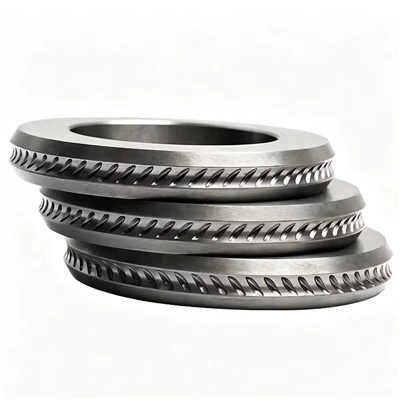
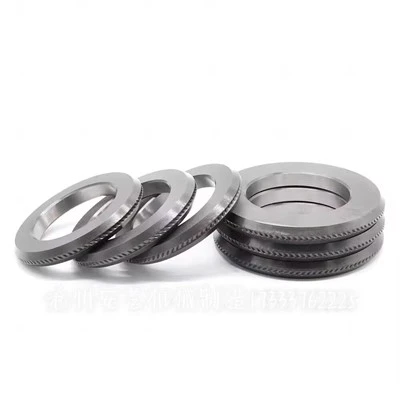
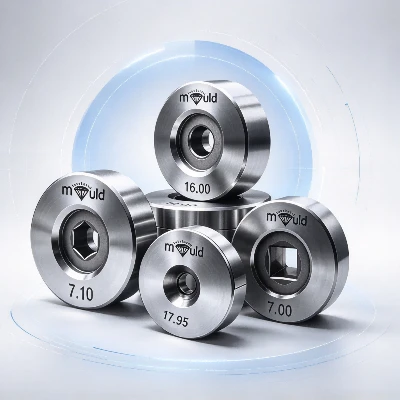
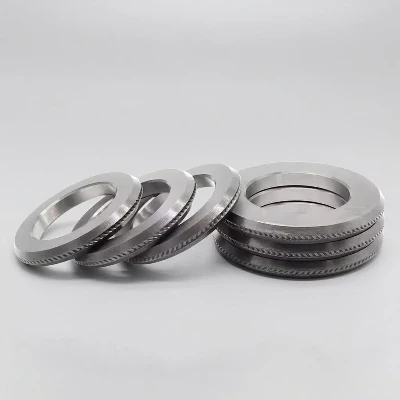
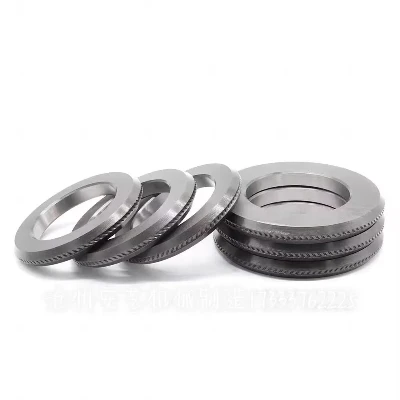
Tungsten Carbide Roll Rings
Carbide roll rings are annular rolling components installed in compatible roll shafts or assemblies. They are widely considered for wire rod and bar rolling stands where groove wear and dimensional stability are important.
Solid Tungsten Carbide Rolls
Solid carbide rolls are manufactured as integrated components. They are suitable for applications where the required roll dimensions, mechanical loading, and equipment configuration support a full-carbide structure.
Composite Carbide Rolls
Composite configurations combine a tungsten carbide working section with a supporting metal structure. This design can reduce carbide material consumption while providing a suitable load-bearing assembly.
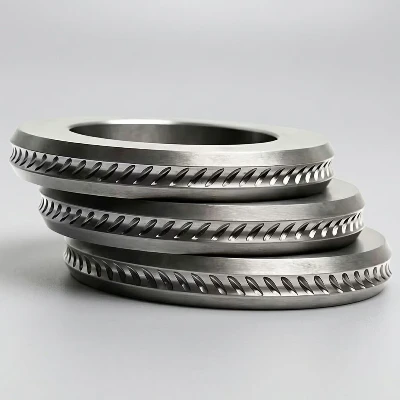
Grooved Carbide Rolls
Grooved rolls feature precision-machined working profiles for different rolling passes. Groove geometry is customized according to the incoming billet size, target product section, and rolling sequence.
Applications in Rolling Mills
| Rolling Mill Application | Typical Products |
|---|---|
| High-Speed Wire Rod Mills | Steel wire rods and finishing products |
| Bar Rolling Mills | Round bars, square bars, and reinforcing bars |
| Small Section Mills | Angles, channels, and customized steel sections |
| Precision Rolling Lines | Small-diameter metal products and dimensional sizing |
| Non-Ferrous Rolling Mills | Copper, aluminum, and selected alloy products |
Carbide Grade Selection for Rolling Mills
The working performance of cemented carbide rolls is determined by WC grain size, cobalt binder content, density, and microstructural quality.
| Grade Factor | Technical Influence |
|---|---|
| Fine WC Grain | Supports higher hardness and wear resistance |
| Coarse WC Grain | Can improve toughness in suitable compositions |
| Higher Cobalt Content | Generally increases toughness and strength |
| Lower Cobalt Content | Generally increases hardness and wear resistance |
| High Material Density | Helps reduce porosity-related weaknesses |
| Controlled Sintering | Supports consistent mechanical properties |
For finishing stands, wear resistance and groove retention are often major priorities. For stands exposed to heavier loads or greater mechanical disturbance, toughness and resistance to cracking must receive additional attention.
Selecting a carbide grade based only on hardness is not sufficient. The rolling material, pass reduction, rolling speed, cooling conditions, and mill stability should all be considered.
Roll Pass Design and Machining
Customized Groove Geometry
Roll pass design determines how the metal is progressively reduced and shaped throughout the rolling line. Each pass must be coordinated with the preceding and following stands.
Common groove configurations include:
Round grooves
Oval grooves
Square grooves
Rectangular grooves
Intermediate reduction passes
Finishing grooves
Customized profile grooves
Dimensional Control
Critical dimensions include roll diameter, groove depth, groove radius, groove spacing, roll width, bore diameter, and mounting dimensions.
Accurate machining helps maintain consistent contact between the roll and workpiece. For paired rolls, matching groove dimensions and alignment are particularly important to avoid uneven deformation.
Surface Grinding
Precision grinding establishes the final roll diameter and groove profile. Surface roughness, roundness, and profile accuracy should be controlled according to the rolling application and finished-product requirements.
Manufacturing Process
1. Raw Material Selection
Tungsten carbide powder and cobalt binder are selected according to the required hardness, toughness, and wear resistance.
2. Powder Mixing and Compaction
The raw materials are mixed uniformly and compacted into roll blanks with appropriate machining allowances.
3. Sintering
Controlled sintering produces a dense carbide structure. Temperature, time, and process conditions influence density, porosity, and mechanical properties.
4. Precision Grinding
The sintered blanks are processed to achieve the required outer diameter, inner diameter, width, and groove geometry.
5. Quality Inspection
Finished products undergo dimensional inspection, hardness testing, surface checks, and other agreed quality-control procedures.
Tungsten Carbide Rolls vs. Alloy Steel Rolls
| Comparison | Tungsten Carbide Rolls | Alloy Steel Rolls |
|---|---|---|
| Hardness | Very high | Depends on steel grade and heat treatment |
| Abrasive Wear Resistance | High | Generally lower |
| Groove Retention | Strong under suitable conditions | More affected by progressive wear |
| Rolling Accuracy | Helps maintain pass geometry | Requires more frequent wear monitoring |
| Impact Tolerance | Depends on carbide grade and roll structure | Generally better |
| Initial Cost | Higher | Generally lower |
| Typical Application | High-wear finishing and sizing operations | Roughing and general rolling operations |
Carbide rolls are particularly useful where frequent groove wear leads to roll changes, production interruptions, and dimensional instability. Alloy steel rolls may remain more suitable for roughing stands with severe impact or unstable material feeding.
Why Choose Customized Carbide Rolls?
Application-Based Material Selection: WC grain size and cobalt content are selected according to rolling conditions.
Precision Pass Profiles: Customized grooves support different steel grades and finished product sections.
Dimensional Consistency: Controlled grinding helps maintain roll geometry and installation accuracy.
Multiple Roll Structures: Solid rolls, carbide rings, and composite configurations are available.
Drawing-Based Production: Manufacturing can follow technical drawings, samples, or existing roll specifications.
Custom Manufacturing and Quotation
We provide customized tungsten carbide rolls for wire rod mills, bar rolling mills, section rolling lines, and other compatible metal-forming equipment.
For technical evaluation, please provide:
Rolling mill type and stand position
Workpiece material and steel grade
Billet or incoming material dimensions
Finished product size and cross-section
Rolling speed and operating conditions
Roll drawings and groove profiles
Required carbide grade and order quantity
These details help determine the appropriate carbide composition, roll structure, and groove machining requirements for your rolling mill.
Hot Tags: tungsten carbide rolls for rolling mills, China tungsten carbide rolls for rolling mills manufacturers, suppliers, factory, carbide rolls, grooved carbide rolls, roll forming carbide rolls, Tungsten Carbide Rolling Rolls, Tungsten Carbide Wire Rolling Rolls, tungsten cold rolling