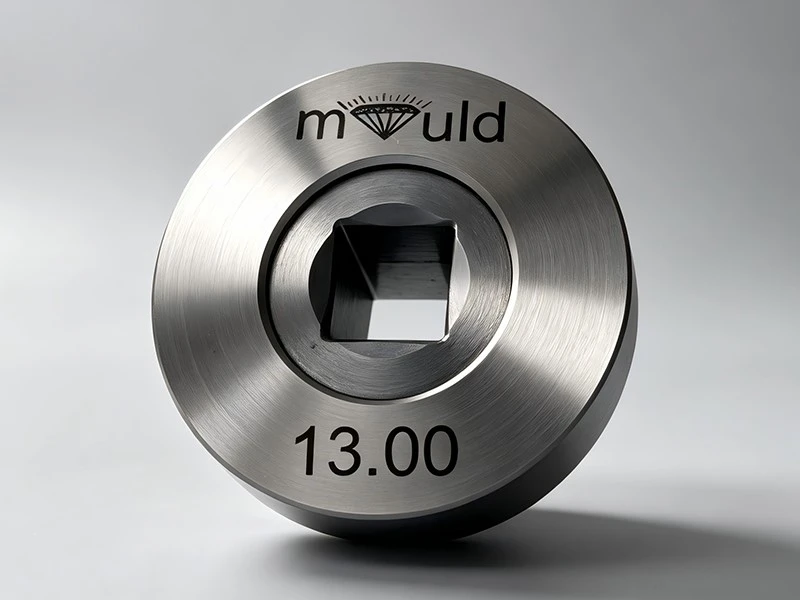
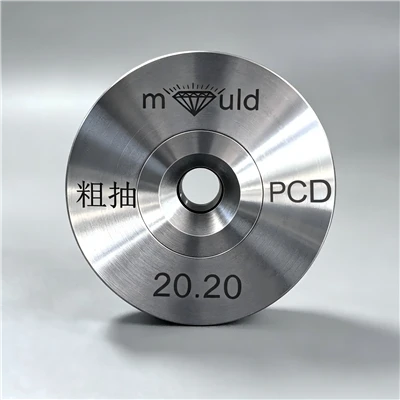
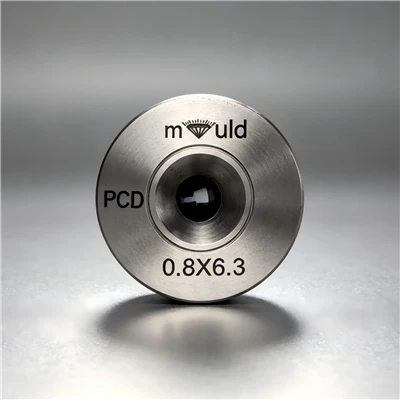
Different shapes of wire drawing dies each have their own unique characteristics.
Circular wire drawing dies are a common type. They are simple in structure, easy to manufacture, and suitable for drawing round wires. They provide a relatively stable drawing effect, producing wires with a high degree of surface smoothness and good dimensional accuracy. They are very suitable for the production of round wires with general requirements.
Square wire drawing dies are mainly used for drawing square or rectangular wires. Their die hole shape is square, allowing control over the cross-sectional shape of the wire. They are useful in applications requiring specific square cross-section wires, such as the leads of electronic components. They ensure that the wire maintains its square shape during the drawing process, ensuring high dimensional accuracy and facilitating subsequent processing and use.
Triangular wire drawing dies are used for drawing triangular wires. This shape of die imparts a unique triangular cross-section to the wire. In some specialized industrial fields, such as aerospace and automotive manufacturing, there is a significant demand for lightweight wires with specific mechanical properties and triangular cross-sections. Triangular wire drawing dies can meet these special requirements, providing specialized wire materials for these fields.
In addition, there are various other irregularly shaped wire drawing dies, such as polygonal wire drawing dies (pentagonal, hexagonal, etc.) and irregularly shaped curve wire drawing dies. Polygonal wire drawing dies can draw polygonal wires with different numbers of sides to meet some special decorative or structural requirements. Irregularly shaped curve wire drawing dies can draw wires with various complex curved shapes, providing a wide range of material choices for art design, decorative materials, and other fields. However, they are more difficult to manufacture, have relatively high costs, and require very strict processing techniques.